
-
 Call: +91-9840269190
-
 Mail: hr@voltechgroup.com

Which is the Best Manpower Agency in India for Europe Recruitment in 2026?
Best Manpower Agency in India for Europe Recruitment - Voltech HR Services Guide 2026
- By Srisivam Selvarajan
- Published: 08 May 2026
- Updated: 30 July 2026
- Written by Srisivam Selvarajan , General Manager - Overseas Recruitment | Voltech HR Services | 10+ years placing skilled and unskilled workers across the Middle East, Germany, Europe and the CIS region from India, the Philippines and Southeast Asia.
Key Takeaways - Quick Reference
A Complete Guide to Europe Recruitment from India
Finding the right manpower agency in India for Europe recruitment is one of the most important decisions a business owner or HR manager can make. With thousands of recruitment agencies in India claiming overseas expertise, the key differentiator is legal licensing: only agencies holding a valid Recruiting Agent (RA) licence from India's Protector General of Emigrants (PGE) are legally authorised to place Indian workers abroad. This guide identifies the additional criteria that separate credible, placement-proven agencies from unreliable intermediaries.
This pillar guide answers every question - from why European companies actively hire Indian workers and what the new India-EU mobility deal changes, to how the visa process works, what documents are needed and why Voltech HR Services stands as one of India's most trusted overseas recruitment partners.
This guide is structured to serve two distinct audiences: (1) European employers and HR managers seeking to hire skilled Indian workers - sections 1-7 cover the employer's evaluation, cost and compliance perspective; and (2) Indian professionals and recruitment agencies managing Europe-bound placements - sections 8-13 cover documents, legal protections, BGV requirements and agency selection criteria.
What is the current state of the India-Europe manpower market in 2026?
The following figures - each drawn from a named, checkable source - explain the scale and shape of India-to-Europe recruitment demand in 2026. We've dropped the 2024-vintage, unsourceable figures from the earlier version of this guide in favour of numbers you can verify yourself.
| Figure | What it Means | Source |
|---|---|---|
| 2.1% | EU-wide job vacancy rate, Q1 2026 - the practical measure of unfilled positions economists use | Eurostat, Job Vacancy Statistics, 2026 |
| 4.1% / 3.8% | Highest national vacancy rates in the EU: Netherlands and Belgium respectively (Q3 2025) | Eurostat Job Vacancy Statistics, via industry analysis |
| ~300,000/year | Foreign skilled workers Germany needs annually to sustain its economy | IAB / German Economic Institute (IW) estimates, reported 2026 |
| 2.1 million | Construction worker deficit across EU member states, 2026 | European Construction Industry Federation (FIEC), 2026 |
| ~1.5 million | Engineering graduates India produces annually - the core of its exportable technical workforce | AICTE-linked reporting, Business Standard / Forbes India |
| 1,800+ | Recruiting agencies currently registered on India's eMigrate portal | eMigrate / Ministry of External Affairs, Government of India |
What does the new India-EU mobility agreement mean for recruitment?
In January 2026, India and the European Union concluded a Free Trade Agreement that, for the first time, includes a dedicated EU-wide mobility framework covering skilled workers, young professionals and students - not just a country-by-country arrangement. The European Commission and the Indian government announced the details of this "comprehensive framework of cooperation on mobility" on 7 February 2026.
Practically, the framework does three things that matter for employers and candidates:
Important caveat: this is a framework agreement, not a single EU-wide visa or an open work permit. National visa rules, salary thresholds and employer sponsorship requirements in each member state still apply, and businesses should continue to plan hiring through the existing country-specific routes covered later in this guide.
Why are European companies hiring Indian workers in 2026?
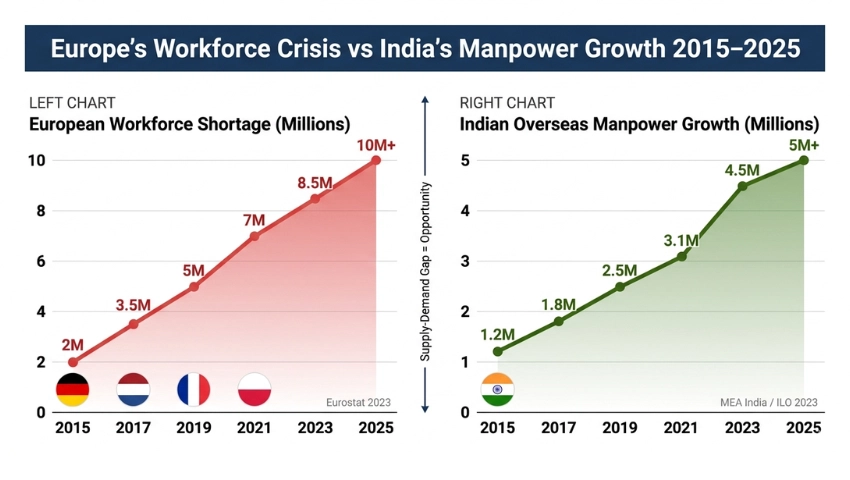
European countries continue to face one of the more severe workforce shortages in the labour market's recent history. Aging populations, low birth rates, and demand in specific sectors have created a persistent gap between vacancies and available domestic workers - a gap Indian talent is well positioned to help fill.
1. Europe's demographic and skills pressure is well documented
Eurostat's job vacancy statistics put the EU-wide vacancy rate at 2.1% in Q1 2026, with the Netherlands, Belgium and Malta running the highest rates. Germany alone is estimated by the Institute for Employment Research (IAB) and the German Economic Institute (IW) to need around 300,000 foreign skilled workers every year just to maintain current staffing levels, with the deepest gaps in healthcare, IT, engineering and skilled trades.
2. Indian workers offer advantages European employers value
3. A formal, EU-wide mobility channel now exists
Unlike the country-by-country Talent Partnerships referenced in earlier versions of this guide, the January 2026 India-EU FTA mobility framework is the first structure to operate at the EU level - creating a more predictable, government-backed channel for Indian manpower agencies to work through, alongside the national visa routes each member state still requires.
What makes a good overseas recruitment agency in India?
Not every manpower agency in India is equipped to handle overseas recruitment - especially Europe placements, which involve multi-jurisdiction compliance, national salary thresholds and strict EU labour law.
The following qualities are worth checking before you engage an agency for Europe placements. Absence of any one of them meaningfully increases placement failure risk:
| Quality | Why it Matters | Voltech HR Status |
|---|---|---|
| PGE / eMigrate Licensed | Legal authority to place candidates abroad | Fully Licensed |
| Proven Track Record | Reduces placement failure risk | 15+ Years, 5,000+ Placements |
| Background Verification Capability | Ensures candidate authenticity | In-House BGV Team |
| Visa Documentation Expertise | Increases approval rates | 92% Visa Approval Rate (company-reported) |
| Sector Specialisation | Matches right talent to right role | 12+ Industry Verticals |
| Post-Placement Support | Reduces drop-outs and replacements | 90-Day Post-Join Support |
| Transparent Fee Structure | Builds employer and candidate trust | Zero Hidden Charges |
| Dedicated Account Manager | Smooth communication end-to-end | Single POC per Client |
Which industries are hiring Indian manpower in Europe in 2026?
European demand for Indian workers spans nearly every major industry, though the sharpest shortages sit in IT, healthcare, construction and manufacturing:
| Industry | Roles in Demand | Top Hiring Countries |
|---|---|---|
| Information Technology | Software Engineers, Data Analysts, Cybersecurity (Germany reports ~109,000 unfilled IT roles - Bitkom, 2025) | Germany, Netherlands, France |
| Healthcare | Nurses, Doctors, Medical Technicians | Germany, France, Spain |
| Engineering & Construction | Civil, Mechanical, Electrical Engineers (EU-wide construction deficit: 2.1M - FIEC, 2026) | Germany, Poland, Romania |
| Hospitality & Tourism | Hotel Staff, Chefs, Event Managers | Spain, Italy, Portugal |
| Manufacturing | CNC Operators, Quality Technicians, Supervisors | Poland, Czech Republic, Hungary |
| Agriculture | Farm Supervisors, Irrigation Experts | Netherlands, Spain, Portugal |
| Logistics & Warehousing | Warehouse Supervisors, Logistics Coordinators | Netherlands, Germany, Belgium |
Which roles have the highest placement success rate for Indian candidates in Europe?
Based on Voltech HR Services' internal placement data (company-reported, not an independent audit), the following roles have seen the strongest placement outcomes:
Which European countries are facing the biggest workforce shortages in 2026?
Understanding which countries have the tightest labour markets helps both employers and candidates prioritise. The table below uses Eurostat's job vacancy rate - the standard, comparable measure of how tight a national labour market is - alongside sector-specific shortage data where an official or industry source publishes it:
| Country | Job Vacancy Rate | Key Sectors Hiring | Note |
|---|---|---|---|
| Netherlands | 4.1% | Logistics, Agriculture, Tech | Highest vacancy rate in the EU (Eurostat, Q3 2025) |
| Belgium | 3.8% | Logistics, Healthcare, Construction | Eurostat, Q3 2025 |
| Germany | 2.8% | Engineering, IT, Healthcare | Above EU average; ~300,000 foreign workers needed/year (IAB/IW) |
| Poland | Moderate | Manufacturing, Logistics | One of the lowest EU Blue Card salary bars (~€37,200/yr) |
| Spain | Moderate | Agriculture, Hospitality, IT | Blue Card threshold re-based mid-2026 to €41,356 |
| Portugal | Moderate | Tourism, Construction, IT | Among the lowest Blue Card salary bars in the EU |
| France | Near EU average | Healthcare, Engineering, IT | Talent Passport route remains the main channel |
| Romania | Moderate | Construction, Healthcare | Faster visa timelines than Western Europe |
What is the EU Blue Card and what are the 2026 salary thresholds?
The EU Blue Card is a residence and work permit for highly qualified non-EU nationals, revised under Directive (EU) 2021/1883. Each member state sets and updates its own salary threshold, typically between one and 1.6 times the national average gross salary, so the figure that matters is the one for the specific country your candidate is applying to.
| Country | 2026 Standard Threshold | Reduced / Shortage-Occupation Threshold |
|---|---|---|
| Germany | €50,700/year | €45,934.20/year (shortage roles, recent graduates, eligible IT specialists without a degree) |
| Spain | €41,356.36/year | €33,085.09/year (recent graduates) |
| Poland | ~€37,200/year (PLN 13,355/month) | Pegged to 1.5x national average salary (GUS) |
| Luxembourg | €65,652/year | Effective from 3 March 2026 |
In Germany specifically, IT specialists can qualify for the Blue Card without a formal degree if they can show at least three years of relevant professional experience - a route several of our IT placements have used in 2026.
Why is Germany the top European destination for Indian workers in 2026?
Germany remains the leading European destination for Indian skilled workers in 2026 because of the scale of its workforce gap and its structured immigration pathways for non-EU professionals.
Germany's Skilled Immigration Act (Fachkräfteeinwanderungsgesetz) continues to widen access for qualified Indian professionals across engineering, IT, healthcare and manufacturing, and independent estimates put Germany's annual need at roughly 300,000 foreign skilled workers (IAB/IW), with Bitkom separately reporting around 109,000 unfilled IT roles as of 2025.
Key advantages for Indian workers in Germany include:
Germany continues to be one of the most preferred countries in Europe for Indian professionals seeking long-term career growth and international work opportunities.
How does the Europe recruitment process work for Indian candidates?
The overseas recruitment process from India to Europe follows a structured, legally-defined pathway. Here is how it works when you partner with a professional manpower agency like Voltech HR Services:
| Step | Stage | Timeline | Voltech HR Services Action |
|---|---|---|---|
| 1. | Job Order from Employer | Day 1 | Receive JD, analyse skill requirements |
| 2. | Candidate Sourcing & Screening | Days 2 - 10 | Database search + fresh sourcing |
| 3. | Skills Assessment & Interview | Days 7 - 15 | Technical + behavioural tests |
| 4. | Document Verification (BGV) | Days 10 - 18 | Structured background check |
| 5. | Employer Interview | Days 15 - 25 | Coordinate video/in-person rounds |
| 6. | Visa / Blue Card Application & Filing | Days 25 - 70 | Full visa documentation support, incl. labour-agency approval where required |
| 7. | Pre-Departure Orientation | Days 65 - 85 | Cultural, legal, financial briefing |
| 8. | Candidate Onboarding in Europe | Days 85 - 120 | Post-landing support provided |
How long does the entire process take?
The India-to-Europe recruitment process generally takes 60 to 120 days for most countries. Timelines vary depending on visa processing, employer approvals and document verification requirements. Germany can take longer where Bundesagentur für Arbeit pre-approval applies (typically adding 2-4 weeks for roles below the unrestricted Blue Card salary threshold), and the Netherlands may take longer where credential recognition is required.
Voltech HR Services supports employers and candidates with recruitment coordination, documentation assistance and workforce onboarding throughout the hiring process.
What is the role of a manpower agency during the visa process?
A licensed overseas recruitment agency's role in the Europe visa process spans several active responsibilities - from obtaining demand-letter attestation in India to arranging pre-departure medical clearances. Voltech HR performs the following actions during the visa stage of every placement:
What documents are required for Europe recruitment from India?
Document preparation remains one of the most preventable reasons for Europe visa rejections. Based on Voltech HR's internal visa rejection review (company-reported), incomplete or inconsistent documentation is consistently the most common cause of avoidable delays and rejections in Indian candidates' Europe applications.
| Document Category | Required Documents | Who Provides It |
|---|---|---|
| Identity | Passport (min. 2-yr validity), National ID | Candidate |
| Education | Degree certificates, Marksheets, Skill certificates | Candidate + Institution |
| Experience | Experience letters, Relieving letters, Payslips | Previous Employer |
| Medical | Medical fitness certificate from authorised doctor | Approved Medical Centre |
| Police Clearance | PCC from local police/passport office | Government Authority |
| Employer-Side | Job offer letter, Employment contract, Labour approval | European Employer via Voltech |
| Visa | Schengen/National Visa or EU Blue Card application, biometrics, photos | Candidate + Embassy |
| Insurance | Travel and health insurance cover | Voltech-Recommended Partners |
What are the legal protections for Indian workers going to Europe?
Indian workers employed in Europe are protected under two parallel frameworks that apply simultaneously: Indian law (Emigration Act 1983, the eMigrate system, MEA/embassy support) and European Union or national law (the EU Posted Workers Directive, GDPR, and the minimum wage and labour rules of each member state).
Indian Legal Framework
European Legal Framework
How does Voltech HR Services compare to other manpower agencies in India?
Not all manpower agencies in India have the licensing or country-specific expertise for Europe recruitment. The figures below are Voltech HR's own company-reported track record, shared here for transparency rather than as an independently audited benchmark.
| Trust Factor | Detail |
|---|---|
| Established Since | 15+ Years of Active HR and Recruitment Operations |
| Placements Completed | 5,000+ successful placements across domestic and overseas markets |
| Visa Approval Rate | 92% (company-reported) |
| Industries Served | IT, Healthcare, Engineering, Manufacturing, Hospitality, FMCG, Logistics |
| Services Portfolio | Overseas Recruitment, Domestic Recruitment, Staffing, Payroll, BGV, Corporate Events |
| Compliance Standard | Compliant with Emigration Act 1983 and eMigrate registration requirements |
| Geographic Reach | Recruitment and workforce solutions support across Europe, the Middle East and international markets |
| BGV Capability | In-house background verification support for identity, employment and document checks |
| Post-Placement Support | Recruitment coordination and onboarding support for overseas workforce placements |
What services does Voltech HR Services provide?
Frequently Asked Questions About Europe Recruitment from India (2026)
Q1. Which is the best manpower agency in India for Europe recruitment?
The best manpower agency for Europe recruitment from India is one that holds a valid RA licence from the Protector General of Emigrants, has documented placement success in Europe, maintains in-house BGV and provides post-placement support. Voltech HR Services reports meeting these criteria with 15+ years of placement experience across Germany, Netherlands, Portugal, Spain, France and more.
Q2. What is the new India-EU mobility agreement, and does it replace existing visa processes?
No. The India-EU FTA's mobility framework, concluded in January 2026 and detailed in February 2026, is a facilitative structure that sits alongside - not instead of - existing national visa routes such as Germany's Skilled Worker Visa and the EU Blue Card. Employers still need to sponsor a candidate and meet the relevant country's salary threshold and documentation requirements.
Q3. Can a manpower agency in India place workers in Germany?
Yes. Licensed Indian manpower agencies can place workers in Germany under the Skilled Immigration Act and the EU Blue Card route. The agency must coordinate with the German employer for a valid job offer, complete the eMigrate registration and assist the candidate through the German visa or Blue Card process, including Bundesagentur für Arbeit pre-approval where the offered salary falls below the unrestricted threshold.
Q4. What is the cost charged by recruitment agencies for Europe placements?
Employer-side fees typically range from 8-15% of annual CTC or a fixed placement fee agreed upfront. For ECR-category roles, candidates cannot be charged any fee under Indian law. For non-ECR roles, any service fee must be declared transparently in the recruitment agreement.
Q5. How long does it take to send a candidate from India to Europe?
The standard timeline is 60 to 120 days for most European countries. Germany and the Netherlands can run longer where labour-agency pre-approval or credential recognition applies. The process includes candidate sourcing, BGV, employer interview, visa filing and pre-departure preparation.
Q6. Is background verification mandatory for overseas recruitment?
Not universally mandated by Indian law for every category, but most European employers contractually require BGV before visa processing. Voltech HR conducts BGV on every candidate as a quality standard, since unverified candidates are a leading cause of overseas placement failures.
Q7. Which European countries have the most demand for Indian workers in 2026?
In 2026, Germany continues to lead demand for Indian workers by absolute volume, while the Netherlands and Belgium currently post the EU's highest job vacancy rates (Eurostat). Poland, Portugal and Spain offer some of the lowest EU Blue Card salary thresholds, which makes them increasingly accessible entry points for mid-career Indian professionals.
Q8. What is the eMigrate system and is it mandatory?
The eMigrate system is the Ministry of External Affairs India's digital platform for registering overseas job orders under the Emigration Act, 1983. All recruitments involving ECR (Emigration Check Required) passport holders must be registered on eMigrate before the candidate can depart. Voltech HR Services completes eMigrate registration as a standard step in all overseas placements.
Q9. Can Voltech HR Services also manage payroll for workers placed in India?
Yes. Voltech HR's Staffing & Payroll division manages end-to-end payroll for both contract workers deployed across India and permanent employees for clients who outsource payroll processing. This includes PF, ESI, TDS compliance and monthly payslip generation.
Q10. How does Voltech HR Services handle candidates who face issues after reaching Europe?
Voltech HR maintains a 90-day post-placement support window for every overseas candidate. This includes a dedicated point of contact for the candidate, coordination with the employer's HR team and - in distress situations - guidance toward the Indian embassy in the destination country. Candidates receive embassy contact details as part of their pre-departure briefing.
Q11. What industries does Voltech HR specialise in for Europe recruitment?
Voltech HR has active placement pipelines in IT & Technology, Healthcare & Nursing, Engineering & Construction, Manufacturing & Quality Control, Hospitality & Food Service, Logistics & Supply Chain and Agriculture & Agri-Tech for European markets.
Related Resources for Employers & HR Leaders
Looking to strengthen your international hiring strategy and workforce operations? Explore our in-depth recruitment and manpower guides:
→ How to Legally Hire Workers from India & the Philippines for Germany - Learn the legal recruitment process for hiring international workers for Germany, including visa pathways, documentation requirements, compliance procedures and overseas workforce onboarding strategies for employers.
→ Brunei Labor Shortage Guide for Employers - Explore the growing labour shortage challenges in Brunei across construction, hospitality, engineering and industrial sectors. Understand how overseas recruitment and workforce planning help businesses meet manpower demand.
→ Why European Companies Need Indian Talent for Future Recruitment - Discover why European employers increasingly hire Indian professionals across IT, healthcare, engineering, logistics, manufacturing and skilled trade sectors to address long-term workforce shortages and demographic challenges.
Ready to simplify your HR operations? Free consultation - 24-hour response guaranteed
Every day you manage HR manually is a day lost from your core business. Whether you need one service or a complete HR partnership - recruitment, payroll, background verification or corporate events - Voltech HR has the team, the licences and the 15-year track record to deliver it right.
Tell us your HR challenge. Our specialist team will respond within 24 hours with a tailored solution - no obligation, no hidden fees.
Write Comment