
-
 Call: +91-9840269190
-
 Mail: hr@voltechgroup.com

Background Verification Process in India: How Companies Run Employee Screening End to End
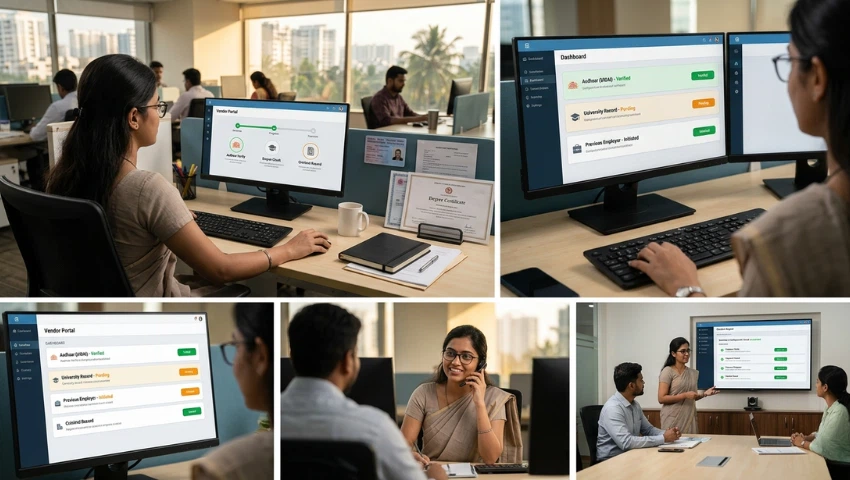
- This article is reviewed by HR compliance practitioners with experience in DPDP Act implementation, background verification audits and Indian labour law. Sourced from government notifications, SHRM India research and licensed BGV industry data.
Published:April 19, 2026
Key Takeaways:
• The background verification process in India runs through 7 sequential stages: consent, document collection, case creation, active verification, quality control, report generation and onboarding decision. Each stage is a dependency - skipping one breaks the one that follows.
• Standard packages (identity + education + employment) complete in 5 to 9 working days. Comprehensive packages including criminal records, address and CIBIL checks take 10 to 14 working days.
• The DPDP Act 2023 makes documented, specific, revocable candidate consent a legal prerequisite - not a procedural formality - before any single check can be initiated.
• Stage 5 (quality control) is the most overlooked stage in outsourced BGV. Automated systems confirm data matches; QC analysts catch the contextual inconsistencies that automated checks miss entirely.
• BGV reports classify findings into three statuses: Green (clear), Amber (minor discrepancy requiring HR review) and Red (material fraud or misrepresentation).
• The most common fraud patterns in India are fabricated degrees, inflated job titles with matching employment periods and address records that pass digital checks but fail physical verification in Tier-2 and Tier-3 cities.
• Post-onboarding re-verification - periodic checks on existing employees - is mandatory under RBI guidelines for BFSI staff in senior roles and recommended for finance, data and C-suite roles across all sectors.
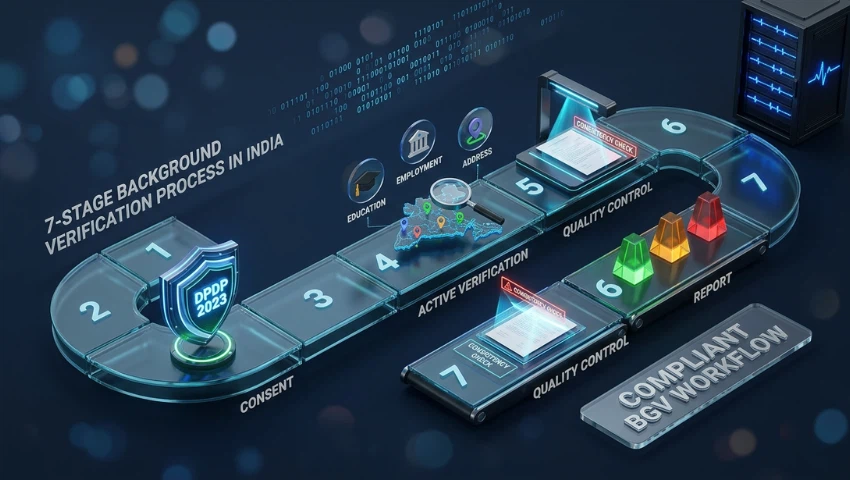
What the Background Verification Process in India actually involves
The background verification process in India is not a single database query or a checklist of document scans. It is a multi-stage, document-driven workflow involving four parties: the employer's HR team, the candidate, the BGV service provider (if outsourced) and the source institutions that hold the original records - universities, previous employers, government databases and court systems.
Two statutes govern how every stage of this process must be conducted: the Digital Personal Data Protection (DPDP) Act 2023, which governs candidate data collection, consent, storage and deletion; and the Information Technology Act 2000, which covers digital document verification, electronic consent and data security obligations.
In regulated sectors - Banking and Financial Services, Healthcare and Government Contracting - the process carries additional mandatory checks under RBI, MCI/NMC and contracting authority frameworks. For all other sectors, DPDP Act compliance obligations apply regardless.
Why process matters more than tools: Many companies underinvest in the BGV process itself while overinvesting in technology platforms. A sophisticated verification platform running a poorly structured process still produces unreliable results. The seven-stage sequence described in this article reflects how professional BGV providers in India eliminate the gaps that cause missed fraud, compliance exposure and delayed onboarding.
The Fraud Patterns That Make BGV Necessary in India
Understanding why each stage of the BGV process exists requires understanding what it is designed to catch. The following fraud patterns represent the most common misrepresentations discovered in Indian employee background checks , based on industry data from BGV providers operating across BFSI, IT, Healthcare and Logistics sectors.
| Fraud type | How it presents | Which BGV stage catches it |
|---|---|---|
| Fabricated degree or institution | Certificate from a real institution with altered marks, or from a non-existent institution using legitimate-looking formatting | Stage 4 - Education check via direct institution outreach or NAD query |
| Ghost employment | Claimed employer exists but the candidate never worked there or tenure dates are falsified | Stage 4 - Employment verification via official HR channels and EPFO/UAN cross-reference |
| Title inflation | Correct employer and tenure, but senior title claimed for a junior role | Stage 4 - Employment + Stage 5 QC catch the conflict between title and salary records |
| Address fabrication | Residential address passes digital check because documents appear valid, but the location is non-existent or belongs to another person | Stage 4 - Physical field visit for Tier-2/3 addresses; geo-tagged confirmation for Tier-1 |
| Concealed criminal record | No self-disclosure; database query required across state and national court records | Stage 4 - Criminal records check across district, state and national databases |
| Dual employment | Candidate currently employed elsewhere while claiming to have left; common in IT and remote roles | Stage 4 - Employment check + EPFO active employer status cross-reference |
| AI-generated credentials (2025 onwards) | Digitally generated degree certificates, employment letters, or identity documents that pass visual inspection | Stage 4 - Government API authentication (UIDAI, NSDL, NAD) rejects documents not in the original database |
The 7-Stage Background Verification Process: What Each Stage Does and Where it Fails
Each stage below is described operationally: what it does, what can go wrong and what a professional BGV provider does differently from an in-house HR team attempting the same stage without specialist infrastructure.
Stage 1: Consent Collection
Consent collection is not a formality. Under the DPDP Act 2023, it is a prerequisite that must be completed before any data about a candidate is accessed, queried or processed - including identity checks against government databases.
A legally valid consent form must specify: which checks will be conducted; what data will be collected for each; how data will be stored and for how long; the legal basis for processing under the DPDP Act; and the candidate's right to withdraw consent before verification is complete.
Where in-house teams fail at Stage 1: Generic consent forms that bundle BGV consent with onboarding documentation, or that describe checks in vague terms such as 'background screening', are non-compliant. Each check type must be individually specified. Broad consent does not satisfy the DPDP Act's purpose limitation requirement.
Non-compliance consequence: penalties of up to Rs 250 crore per violation under Section 15 of the DPDP Act 2023. The employer - not the BGV vendor - is the Data Fiduciary and bears this liability.
Stage 2: Document Collection
Once consent is obtained, the candidate submits the source documents that will be cross-referenced during verification. These documents do not prove anything by themselves - they are the reference points that verification checks are tested against.
Five document categories are required for a standard BGV:
• Government-issued photo identity (Aadhaar, PAN or Passport) - the primary identity anchor for all subsequent checks
• Educational certificates and transcripts from all claimed institutions
• Offer letters and relieving letters from all previous employers - required for both employment history and title verification
• Address proof for current and permanent residential addresses
• Professional licences and certifications where the role requires them: medical registration, engineering licence, SEBI registration
Where in-house teams fail at Stage 2: Accepting a single identity document as sufficient or failing to collect relieving letters from all employers rather than just the most recent. Missing documents at this stage are the leading cause of 'Insufficient' status on final BGV reports and the most common source of delayed onboarding.
Stage 3: Data Entry and Case Creation
Case creation is the operational handover from HR to the verification workflow. Submitted documents are entered into the BGV platform, each candidate is assigned a unique case file and individual verification tasks are generated for each check type included in the package.
In technology-enabled BGV companies, this stage is automated through direct API integrations with HRMS platforms - Darwinbox, Keka, Workday - so that case creation is triggered automatically when a conditional offer is accepted. This eliminates manual data re-entry, reduces case creation time from hours to minutes and creates a timestamped audit trail that is an important compliance record under the DPDP Act 2023.
Where in-house teams fail at Stage 3: Manual data entry introduces transcription errors that propagate through every subsequent check - a misspelled name or wrong date of birth causes identity checks to fail even when the candidate is legitimate. HRMS integration eliminates this error class entirely.
Stage 4: Active Verification
Stage 4 is the core of the BGV process. Each check is executed independently against the original source record - not against the document the candidate submitted, which may be altered. The table below describes how each check type is conducted and which source it draws from.
| Check type | Verification method | Source institution / database |
|---|---|---|
| Identity (Aadhaar, PAN) | API authentication - Aadhaar number authenticated via UIDAI; PAN authenticated via NSDL Income Tax portal; PAN-Aadhaar linkage cross-verified | UIDAI / NSDL government portals |
| Education | Direct outreach to the issuing institution's registrar or examination board; DigiLocker query for institutions on the National Academic Depository (NAD) | Issuing university / board / NAD |
| Employment history | Official written requests to previous employer HR departments via registered channels; cross-reference of joining and leaving dates against EPFO/UAN contribution records | Previous employer HR teams / EPFO portal |
| Address | Tier-1 cities: geo-tagged digital verification with GPS-stamped photographs; Tier-2/3 cities and rural addresses: physical field visit by local agents | Field agents / government address databases |
| Criminal records | Database queries across district court records, state High Court databases and national-level indices; FIR cross-check with local police station records | State court systems / police records / national databases |
| Credit history (if required) | Credit bureau pull with separate candidate consent - required for BFSI and finance roles | CIBIL / Experian |
| Professional references | Structured telephone interview with listed supervisors; verification that the reference contact is a real employee of the named organisation | Candidate-provided references, independently verified for legitimacy |
Why government API checks matter: Document fraud detection depends on checking the candidate's document against the issuing authority's live database - not against the document itself. A fabricated Aadhaar card may look identical to a genuine one. The UIDAI API either confirms the number exists and matches the biometric profile, or it does not. There is no visual inspection equivalent that achieves this.
Stage 5: Quality Control
Quality control is the stage that separates professional BGV providers from automated-only verification platforms. A trained QC analyst reviews all verified data points before the report is assembled, checking not just whether data matches but whether it is internally consistent.
Automated verification systems are designed to confirm matches: does this name match the Aadhaar record? Does this degree appear in the NAD? Does this employment period match EPFO records? They are not designed to identify logical contradictions across data points.
The following discrepancy types are routinely caught at Stage 5 that pass automated checks:
• A job title confirmed by the previous employer that is inconsistent with the salary level claimed by the candidate
• A degree certificate dated before the institution was founded, or from a course the institution did not offer at that time
• An address that passes digital geo-verification but fails physical field check - typically when a candidate uses a commercial or institutional address as a residential address
• Employment dates confirmed by EPFO records that conflict with the candidate's claimed start date in their application
• A reference contact who works at the named company but was not employed there during the period the candidate claims to have worked there
The QC failure mode: BGV providers that issue reports based solely on automated checks without human QC review produce Green reports for candidates with material discrepancies. The discrepancy is not in the data - it is in the relationship between data points. Only a trained analyst reading the full case file catches it.
Stage 6: Report Generation
The consolidated BGV report is prepared for each candidate and shared with the employer's HR team through a secure portal or dashboard. The report contains the verification outcome for each check type, the source institution or database that confirmed or disputed each data point and supporting documentation for any discrepancy flagged.
Reports use a three-status classification system:
| Status | What it means | Employer action required |
|---|---|---|
| Green | All checks cleared with no discrepancies identified across any check type | Onboarding can proceed |
| Amber | A minor discrepancy is noted on one or more checks - for example, a job title variation between the candidate's claim and the employer's records, or a minor date discrepancy in education records. The discrepancy is documented with supporting evidence. | HR review required before decision; discrepancy must be assessed against role requirements and seniority. Decision must be documented. |
| Red | A material misrepresentation or confirmed fraud is detected - fabricated qualification, concealed criminal conviction, false employer, or identity discrepancy. Examples include a degree from an institution that has no record of the candidate, or a criminal conviction not disclosed by the applicant. | Offer withdrawal is the standard response. In regulated sectors (Banking, Healthcare), material misrepresentation may be reportable to the regulatory authority or law enforcement. |
Data handling at Stage 6: Candidate data in the BGV report is shared only between the employer and the BGV provider. Data is handled in accordance with DPDP Act 2023 retention obligations and is not shared with any third party. Retention timelines and deletion schedules must be documented in the BGV service agreement.
Stage 7: Employer Decision and Onboarding
The BGV report triggers the employer's final onboarding decision. Green-status candidates proceed to standard onboarding. Amber-status candidates require a documented internal HR review - the decision must record what the discrepancy was, how it was assessed and why the employer chose to proceed or withdraw. Red-status candidates result in offer withdrawal as standard practice.
Post-onboarding re-verification: when BGV continues after joining
Pre-employment BGV is the standard trigger for background checks. Post-onboarding re-verification - periodic checks conducted on existing employees - is a separate and increasingly important process that most Indian companies have not yet formalised.
Three employee categories are subject to post-onboarding re-verification in Indian companies:
| Employee category | Re-verification frequency | Regulatory basis |
|---|---|---|
| Senior leadership and C-suite executives | Annually | RBI recommended practice for BFSI; governance best practice for listed companies |
| Employees in finance, treasury, or data-sensitive roles | Every 12 to 24 months | RBI guidance for BFSI; internal risk policy for other sectors |
| Gig workers, contractors and temporary staff | At each contract renewal or assignment | DPDP Act consent obligations apply at each new engagement; no carryover from prior consent |
Post-onboarding re-verification follows the same seven-stage process as pre-employment BGV and requires fresh DPDP Act 2023 consent from the employee at each re-verification cycle. Consent obtained during initial hiring cannot be used as the basis for subsequent checks.
How to Diagnose Gaps in Your Current BGV Process
Most Indian companies running BGV - whether in-house or through a vendor - have at least one structural gap in their process. The following diagnostic questions identify the most common failure points.
| Diagnostic question | If the answer is no, the gap is: |
|---|---|
| Does your consent form name each specific check that will be conducted? | DPDP Act non-compliance. Broad or bundled consent does not satisfy purpose limitation requirements. |
| Do you collect relieving letters from every previous employer, not just the most recent? | Employment verification gap. Title fraud and tenure falsification are invisible without multi-employer document review. |
| Are Aadhaar and PAN verified against live government APIs, not document scans? | Identity verification gap. Document fraud detection requires database authentication, not visual inspection. |
| Do you conduct physical field visits for candidate addresses in Tier-2 and Tier-3 cities? | Address verification gap. Digital-only checks miss location fraud in non-metro areas. |
| Does a trained QC analyst review all findings before the report is issued? | Accuracy gap. Automated checks confirm data matches but cannot identify cross-case inconsistencies. |
| Do you have a documented data retention and deletion schedule for candidate BGV data? | DPDP Act compliance gap. Indefinite retention of candidate data without a documented deletion policy is a violation. |
| Are your highest-risk employees subject to periodic re-verification post-joining? | Ongoing risk gap. Pre-employment checks become stale; employees in sensitive roles require periodic re-verification. |
Employee Background Verification Process in india - Common Questions
1. Can BGV be conducted after an employee has joined?
Yes. Post-joining BGV is used in three specific situations: when a lateral hire joins before the full report is complete due to business urgency and the employer accepts interim risk with documented rationale; when a company initiates a retroactive BGV programme for existing employees who were hired before the programme was established; and when periodic re-verification is scheduled for employees in sensitive roles. In all three cases, the DPDP Act 2023 requires fresh consent from the employee - consent given during the original hiring cannot be applied to a subsequent verification cycle.
2. What is the difference between BGV and KYC in India?
KYC (Know Your Customer) and BGV operate under different regulatory frameworks and apply to different subjects. KYC is a financial services compliance obligation under RBI guidelines that verifies the identity of customers and counterparties to prevent money laundering and financial fraud. It is a customer-facing process, not an employment process.
BGV is an HR process that verifies a job candidate's professional and personal history before employment. For BFSI companies, both apply but to different parties: KYC is conducted on customers; BGV is conducted on employees. The same individual may be subject to BGV when joining a bank as an employee and to KYC when opening an account as a customer of that same bank. These are independent compliance obligations with different regulatory owners and different legal consequences for non-compliance.
3. Is there a standard BGV format that all Indian companies must follow?
No mandated standard format exists for private sector BGV in India. Companies design their BGV process based on industry sector, regulatory obligations, risk tolerance and hiring volume. However, all Indian employers are subject to DPDP Act 2023 consent and data handling obligations regardless of sector. Banking and Financial Services companies are subject to RBI background verification guidelines. Healthcare employers must meet MCI and NMC standards for clinical roles.
The seven-stage structure described in this article reflects the process architecture used by professional BGV providers operating across Indian industries and represents current industry standard practice. It is not a regulatory mandate - it is a framework that has been refined to balance speed, accuracy and compliance across a wide range of hiring contexts.
4. How do BGV reports handle discrepancies that are not fraud?
Not every discrepancy in a BGV report indicates intentional misrepresentation. Common non-fraud discrepancies include: a name variation between documents due to spelling standardisation (e.g., Suresh vs Suressh); a job title that was used informally but differs from the official HR designation; or an employment period that is off by a week due to notice period counting conventions.
Amber-status findings are specifically designed for these cases. The BGV provider documents the nature of the discrepancy and the evidence supporting it. The employer's HR team then assesses whether the discrepancy is material to the role in question - a title variation for a junior analyst role is a different risk than a title variation for a CFO. The documented HR review and decision form part of the DPDP Act compliance record.
The Conclusion:
The background verification process in India is a seven-stage workflow that protects employers from three distinct risks: financial exposure from mis-hires (which cost between Rs 5,00,000 and Rs 50,00,000 per incident, according to SHRM India research); legal liability under the DPDP Act 2023 from non-compliant data handling; and reputational risk from employees whose credentials were never validated against source records.
The stages most commonly skipped or compressed - consent specificity at Stage 1, physical address verification at Stage 4 and human QC review at Stage 5 - are precisely the stages where the fraud patterns most common in India today are caught. An automated BGV platform without these three stages misses the discrepancies that matter most.
The stages most commonly skipped or compressed - consent specificity at Stage 1, physical address verification at Stage 4 and human QC review at Stage 5 - are precisely the stages where the fraud patterns most common in India today are caught. An automated BGV platform without these three stages misses the discrepancies that matter most.
Companies hiring more than 10 candidates per month benefit from outsourcing to a licensed BGV provider with DPDP-compliant consent workflows, Pan India physical verification capability and a dedicated QC layer - reducing HR operational load while improving the accuracy and compliance documentation of every hire.
Is your BGV process DPDP Act 2023 compliant?
Voltech HR Services builds DPDP-compliant BGV workflows for your industry and hiring volume - ISO 27001:2022 certified, 15+ years of practice, 1M+ verifications completed, Pan India coverage including Tier-2 and Tier-3 cities.
Get a free BGV compliance consultation: +91-9840269190 | hr@voltechgroup.com | www.voltechhrservices.com
Subscribe for latest update

Write Comment