
-
 Call: +91-9840269190
-
 Mail: hr@voltechgroup.com

Gratuity for Fixed-Term Employees in India: How to Calculate, Provision and Budget Under the Code on Social Security (2026 & 27 Guide)
Gratuity for Fixed-Term Employees in India: How to Calculate, Provision and Budget Under the Code on Social Security (2026 & 27 Guide)
- Published:
- Last updated:
- By Voltech HR Services, Staffing & Payroll Team
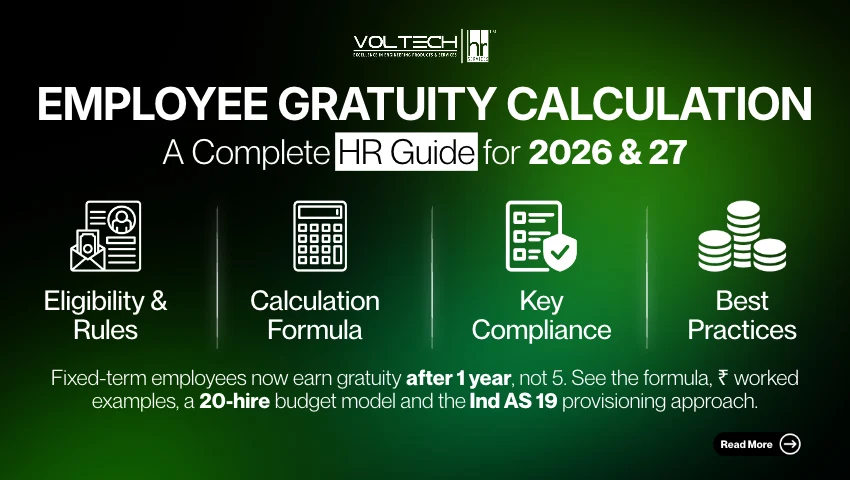
- One year, not five. Since 21 November 2025, a fixed-term employee earns gratuity after one year of service under the contract. Permanent employees and workers supplied by a contractor still need five years.
- The formula is unchanged. Gratuity = (15 ÷ 26) × last-drawn monthly wages × years counted. On wages of ₹30,000, one year is worth ₹17,308.
- Part-years round at six months. Under the Central Rules, service beyond one year counts as an extra year only if it exceeds six months. A 17-month contract pays for 1 year; a 19-month contract pays for 2.
- Budget about 4.81% of monthly wages, which is ₹1,442 a month on ₹30,000 of wages.
- Book it as past service cost. ICAI treats the increase in gratuity liability from the Labour Codes as past service cost, expensed immediately under Ind AS 19.
- Some points are still open: renewals, exactly six months of service and Tamil Nadu’s state rules. Take legal advice before relying on a position.
A fixed-term employee in India now earns gratuity after completing one year of service under the contract, not five. This follows from Section 53 of the Code on Social Security, 2020, in force since 21 November 2025, and the Social Security (Central) Rules, 2026, notified on 8 May 2026. The amount is 15 days’ wages for each year counted: (15 ÷ 26) × last-drawn monthly wages × years of service.
For employers, this changes the books. A 12-month or 24-month contract used to end with no gratuity to pay. Now it ends with a payment due within 30 days. Take 20 fixed-term hires on ₹30,000 wages, spread across 12-, 24- and 36-month contracts. Their gratuity comes to ₹6,40,385 over the life of the contracts, about one month of the team’s ₹6,00,000 monthly wage bill, and none of it existed under the five-year rule.
Three things trip employers up: deciding who is really a “fixed-term employee” (workers supplied by a contractor are different), counting part-years, and choosing a wage base now that the wage definition has changed. This guide covers each with ₹ examples, shows how to budget and book the provision, and marks where the law is still unsettled.
In this guide: the change from the 5-year rule, who qualifies, the formula and rounding, the wage base, worked examples, a 20-hire budget model, the accounting treatment, renewal and contractor risks, payment deadlines, Tamil Nadu rules, a 90-day plan and ten FAQs.
What Changed for Fixed-Term Employees Under the Code on Social Security?
The table compares the old and current position.
| Aspect | Payment of Gratuity Act, 1972 (old) | Code on Social Security, 2020 (now) |
|---|---|---|
| Where it sits | Standalone Act | Chapter V, sections 53 to 58 |
| Permanent employees | 5 years of continuous service | 5 years (unchanged) |
| Fixed-term employees | No special route; 5 years | 1 year of service under the contract, paid pro rata |
| Formula | 15 ÷ 26 × wages × years | Same |
| Wage base | Basic pay plus DA; most other allowances excluded | “Wages” as defined in the Code, with the 50% rule |
| Part-year rule | More than 6 months counts as a full year | Same, plus a fixed-term rule in the Central Rules (see below) |
| Ceiling | ₹20 lakh | Set by the Central Government; ₹20 lakh is the working figure |
| Payment deadline | 30 days | 30 days (section 56(3)); simple interest on delay |
The one-year threshold is confirmed in the Ministry of Labour’s additional FAQs of 16 March 2026. The ₹20 lakh figure comes from the 2018 notification under the old Act; we did not find a fresh notification under the Code, so confirm the current ceiling before you provide for senior-band employees.
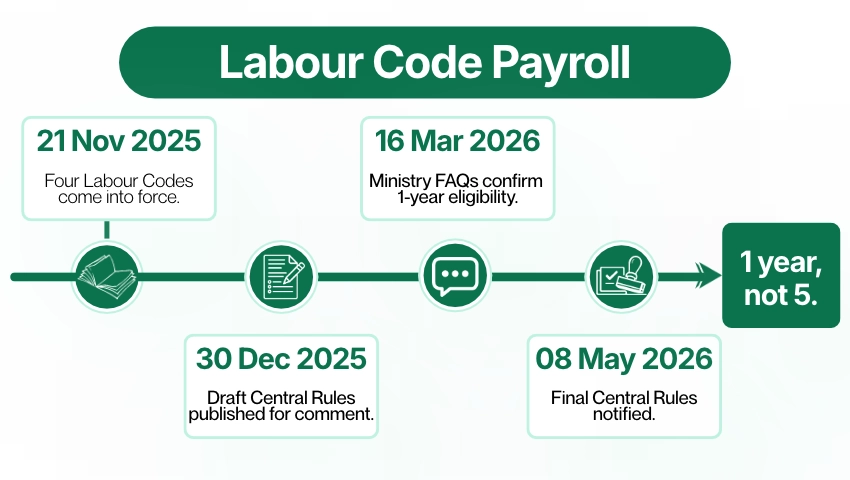
Timeline: How the Fixed-Term Rule Reached Payroll
| Date | Event | Source |
|---|---|---|
| 21 Nov 2025 | The four Labour Codes come into force | BusinessToday |
| 30 Dec 2025 | Draft Social Security (Central) Rules published for comment | PRS Legislative Research |
| 16 Mar 2026 | Ministry of Labour issues additional FAQs confirming one-year eligibility | Ministry of Labour FAQs |
| 8 May 2026 | Final Social Security (Central) Rules, 2026 notified (G.S.R. 344(E)) | PRS Legislative Research, KPMG |
Who Counts as a Fixed-Term Employee, and Who Does Not?
| Worker Category | Legal Employer | Gratuity Threshold | Who Pays |
|---|---|---|---|
| Permanent employee | You | 5 years of continuous service | You |
| Fixed-term employee (direct, written contract) | You | 1 year under the contract, pro rata | You |
| Contract labour supplied through a contractor | The contractor | 5 years of continuous service | The contractor (see the principal-employer risk later in this guide) |
The distinction matters because contract labour is large. The Annual Survey of Industries for 2023-24 shows contract workers at 42% of the organised manufacturing workforce, the highest since 1997-98 and up from about 20% in 1999-2000. Those are workers hired through contractors, so they do not automatically get the one-year route. A “contract” label on the muster roll does not decide the threshold. The legal employer and a written fixed-term contract do.
What HR can do:
- Tag every worker with the legal employer (you or a contractor) and the contract type.
- Check that each fixed-term contract names a fixed period and is in writing.
- Keep contractor-supplied workers off your fixed-term gratuity register, and track them under your contractor agreements instead.
For the commercial side of this choice, see our guides on contract, temporary and permanent staffing and contract staffing in India.
How Is Gratuity Calculated for a Fixed-Term Employee?
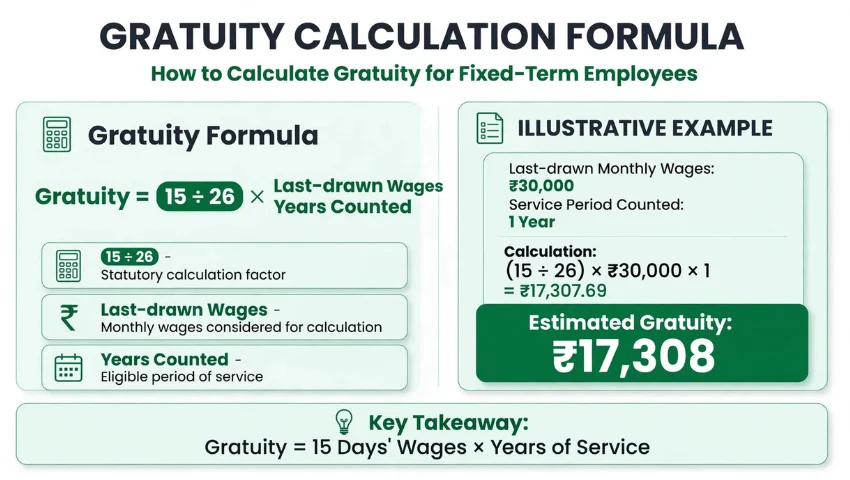
Follow these five steps:
- Confirm eligibility. The person is a direct fixed-term employee, on a written contract, with at least 12 months of service under it.
- Take last-drawn monthly wages at the end of the contract, including any revision.
- Count the years using the rounding table below.
- Multiply: monthly wages × 15 ÷ 26 × years counted.
- Check the ceiling. ₹20 lakh is the working figure until a fresh notification says otherwise.
| Service Under the Contract | Years Counted | Why |
|---|---|---|
| 11 months | 0 | Below the one-year threshold |
| 12 months | 1 | Threshold met |
| 17 months | 1 | The extra 5 months do not exceed six |
| 19 months | 2 | The extra 7 months exceed six, so they round up |
| 24 months | 2 | Two completed years |
| 30 months | 2 or 3 | Exactly six extra months is a boundary case; the text says “in excess of six months”, so a literal reading counts 2 |
| 31 months | 3 | The extra 7 months round up |
| 36 months | 3 | Three completed years |
Which Wage Base Should Payroll Use After the New Wage Definition?
The table shows the minimum wage base and the gratuity it produces. It is simplified: it assumes the 50% test sets the base, and your actual base may be higher if more components count as wages.
| Monthly Gross Pay | Minimum Wage Base (50% Test) | Gratuity per Year of Service | Monthly Accrual |
|---|---|---|---|
| ₹30,000 | ₹15,000 | ₹8,654 | ₹721 |
| ₹40,000 | ₹20,000 | ₹11,538 | ₹962 |
| ₹50,000 | ₹25,000 | ₹14,423 | ₹1,202 |
| ₹60,000 | ₹30,000 | ₹17,308 | ₹1,442 |
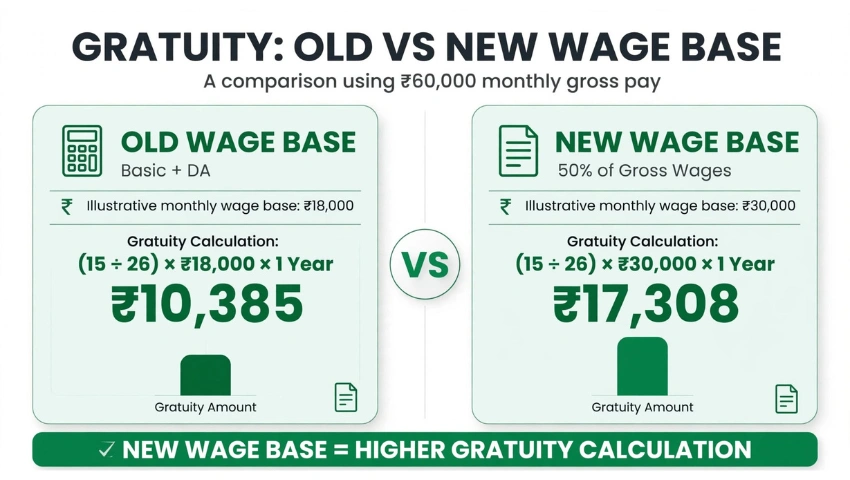
Old base versus new base, same employee. Take gross pay of ₹60,000 with basic pay of ₹18,000. On the old basic-plus-DA shorthand, gratuity is ₹10,385 per year of service. On the minimum new base of ₹30,000, it is ₹17,308, which is 67% higher with no change to salary.
Two cautions:
- Special allowance. Whether a generic special allowance counts as wages has no case law yet. Practitioner analysis leans towards counting it, but take advice before you reclassify anything.
- Final Central Rules. BDO’s review notes that the final Rules dropped the detailed exclusions the draft proposed for gratuity wages, so the Code’s own definition is the starting point.
Our HR compliance and staffing laws guide covers the wider effect of the wage definition on PF, ESI and take-home pay.
Worked Examples: What Does Gratuity Cost at 12, 19, 24 and 36 Months?
| Contract Length | Years Counted | Old Rule (5 Years) | Current Rule | Working |
|---|---|---|---|---|
| 11 months | 0 | ₹0 | ₹0 | Below one year |
| 12 months | 1 | ₹0 | ₹17,308 | 30,000 × 15 ÷ 26 × 1 |
| 17 months | 1 | ₹0 | ₹17,308 | Extra 5 months ignored |
| 19 months | 2 | ₹0 | ₹34,615 | Extra 7 months round up |
| 24 months | 2 | ₹0 | ₹34,615 | 30,000 × 15 ÷ 26 × 2 |
| 36 months | 3 | ₹0 | ₹51,923 | 30,000 × 15 ÷ 26 × 3 |
A wage revision changes every year’s value. Gratuity uses last-drawn wages. If the employee in the 24-month row gets a raise from ₹30,000 to ₹33,000 in month 10, both years are valued at ₹33,000: 33,000 × 15 ÷ 26 × 2 = ₹38,077. That is ₹3,462 more than the ₹34,615 you may have budgeted.
The cost per year is fixed. Each counted year costs 15 ÷ 26 of a month’s wages, which is 57.69% of one month’s wages, or 4.81% of wages for every month of service.
How Should a Business Budget Gratuity for a Team of Fixed-Term Hires?
The 4.81% comes straight from the formula: 15 ÷ 26 is 0.5769 of a month’s wages per year, and 0.5769 ÷ 12 months is 0.0481.
Budget Model: 20 Fixed-Term Hires on ₹30,000 Wages
Assume all 20 start in the same month. The monthly wage bill is ₹6,00,000.
| Group | Headcount | Contract Length | Years Counted | Gratuity Each | Group Total |
|---|---|---|---|---|---|
| A | 8 | 12 months | 1 | ₹17,308 | ₹1,38,462 |
| B | 7 | 24 months | 2 | ₹34,615 | ₹2,42,308 |
| C | 5 | 36 months | 3 | ₹51,923 | ₹2,59,615 |
| Total | 20 | 37 employee-years | ₹6,40,385 |
What this means for the budget:
- Monthly accrual: 4.81% × ₹6,00,000 = ₹28,846, or ₹3,46,154 a year.
- Cash timing: ₹1,38,462 goes out in month 12, ₹2,42,308 in month 24 and ₹2,59,615 in month 36.
- Scale: the full ₹6,40,385 is about 1.07 months of the team’s wage bill.
Why a Straight-Line Accrual Misleads Around the Six-Month Point
The table follows one employee on ₹30,000 wages, accruing ₹1,442.31 a month.
| Months Served | Straight-Line Accrual | Payable if the Contract Ends Here | Gap |
|---|---|---|---|
| 12 | ₹17,308 | ₹17,308 | None |
| 17 | ₹24,519 | ₹17,308 | About ₹7,200 over-accrued |
| 19 | ₹27,404 | ₹34,615 | About ₹7,200 under-accrued |
| 24 | ₹34,615 | ₹34,615 | None |
For contracts with known end dates, budget the amount payable at exit and use the monthly accrual only as a cash-planning tool.
What HR and finance can do:
- Budget by contract end date, not by calendar month.
- Run a renewal scenario: if a renewal takes service from 12 to 24 months, the payable amount doubles.
- Re-run the model whenever wages change, because last-drawn wages value every year.
For cost context on outsourcing this work, see how much payroll outsourcing costs in India.
How Should the Gratuity Provision Be Booked in the Accounts?
The table sets out the treatment, based on the ICAI FAQs and Business Standard’s coverage.
| Question | Ind AS 19 Entities | AS 15 Entities (Indian GAAP) |
|---|---|---|
| How is the increase classed? | Past service cost (plan amendment) | Past service cost (plan amendment) |
| When is it expensed? | Immediately | Vested portion immediately; unvested portion over the vesting period |
| Restate earlier financial statements? | Not required, per ICAI | Not required, per ICAI |
| Pay restructured with no real increase in salary? | The whole increase in gratuity is past service cost | Same |
| Measurement | Actuarial valuation, projected unit credit method | Actuarial valuation, projected unit credit method |
What It Looks Like in the Books
The entries below use the 20-hire team from the budget model. They are illustrative: an actuary’s figure will differ from straight-line because of discounting, attrition and expected renewals, and any one-off past service cost for service already rendered is booked separately.
| Event | Debit | Credit | Illustrative Amount |
|---|---|---|---|
| Monthly accrual | Employee benefit expense: gratuity | Provision for gratuity | ₹28,846 |
| Payment at contract end (Group A, month 12) | Provision for gratuity | Bank | ₹1,38,462 |
A provisioning policy should state:
- Eligibility: direct fixed-term employees only; contractor-supplied workers are excluded.
- Wage base: the components included, and how a special allowance is treated.
- Rounding: whole-year counting with the six-month rule.
- Renewals: whether service across back-to-back contracts is treated as continuous.
- Sign-off: who approves the valuation (your actuary and auditor).
You can also fund the obligation through a group gratuity scheme to smooth cash outflow. Ask your auditor and insurer whether that suits your team size.
What Are the Open Questions on Renewals and 11-Month Contracts?
| Open Question | What We Know | What Is Unsettled | Prudent Stance |
|---|---|---|---|
| Do renewals add up? | The threshold is one year of service under the contract | Whether service across renewals aggregates | Plan as if it may; get a legal view before any contract crosses 12 months |
| Do 11-month contracts avoid the rule? | One 11-month contract is below the threshold | Whether repeated 11-month contracts are treated as continuous | Do not build a workaround; some commentators say Section 53 ends the practice |
| Does earlier service count? | ICAI treats the increase as past service cost, which looks back at prior service | The Ministry’s FAQs do not spell out how a fixed-term employee’s earlier service is counted | Budget on the basis that it counts and confirm with counsel |
| Exactly six extra months? | The Rules say “in excess of six months” | Whether exactly six rounds up | A literal reading excludes it; budget the higher figure if the cost matters |
| State rounding rule | The Central Rules include it | Draft state rules may not | Check your state’s final text |
These gaps come from practitioner analysis of the Ministry’s FAQs and the legal commentary linked above. Treat them as planning notes, not legal conclusions.
Contract Labour Through a Contractor: Who Pays Gratuity, and What Is Your Exposure?
Build these protections into every contractor agreement:
| Check | Why It Matters |
|---|---|
| Contractor warrants payment of all statutory dues, including gratuity | Puts the duty in writing |
| Indemnity if the contractor defaults | Gives you a route to recover costs |
| Monthly proof of PF, ESI and gratuity compliance | An early warning before a default becomes a claim |
| Service history kept when the contractor changes | Whether five years survives a change of contractor is unknown |
| Right to withhold from invoices where dues are unpaid | Protects cash if the contractor falls behind |
Our guides on in-house versus outsourced contract workers, key labour compliance requirements and the labour inspector visit checklist cover the wider contractor-risk picture.
When Must Gratuity Be Paid, and What Happens If You Delay?
Section 56 also requires you to determine the amount and notify both the employee and the competent authority in writing. You can read the text of section 56 for the exact wording.
| When | Action | Owner |
|---|---|---|
| 60 days before contract end | Flag the exit; confirm eligibility and wage base | Payroll |
| 30 days before | Compute gratuity; get finance approval; plan the cash | Payroll and Finance |
| Contract end date | Gratuity becomes payable; determine the amount and notify in writing | HR |
| Within 30 days after | Pay by bank transfer; record it in the full-and-final settlement | Payroll |
| After day 30 | Simple interest runs on any unpaid amount | n/a |
Final wages run on a separate, shorter clock: section 17(2) of the Code on Wages sets two working days after removal, dismissal, retrenchment or resignation. Keep the two timelines apart in your exit checklist.
Which Rules Apply in Tamil Nadu: Central or State?
See JSA’s summary of the Central Rules’ scope, iPleaders’ state tracker and Lakshmikumaran & Sridharan’s Tamil Nadu page.
| Your Situation | Working Approach | Watch For |
|---|---|---|
| Central-sphere or multi-state establishment | Follow the Central Rules: one-year threshold and six-month rounding | Further Ministry FAQs or amendments |
| Tamil Nadu-only establishment | Use the Central Rules as your working convention; the Code’s pro rata provision applies in every state | Tamil Nadu’s final Social Security rules and any change to the rounding rule |
| Units in several states | Apply the Central Rules group-wide and track each state’s notification | State-by-state differences |
Gratuity Action Plan: What to Do in the Next 90 Days
| Window | Action | Owner | Output |
|---|---|---|---|
| Days 1 to 7 | Build a fixed-term register: legal employer, contract start and end, renewal history, wage base | HR and Payroll | Register |
| Days 8 to 30 | Set the wage base band by band under the 50% test; record the special allowance position with counsel | Payroll and Legal | Wage-base note |
| Days 8 to 30 | Model cash needs by contract end date, plus the monthly accrual | Finance | Budget |
| Days 31 to 60 | Get the actuary’s valuation and the auditor’s view on past service cost; draft the provisioning policy | Finance | Provision and policy |
| Days 31 to 60 | Update the fixed-term contract template and contractor agreements | Legal and HR | Revised templates |
| Days 61 to 90 | Add a gratuity line and 60-day expiry alerts to payroll; add the 30-day clock to the exit checklist | Payroll | Live process |
How Does Voltech HR Services Help Employers Manage Fixed-Term Gratuity?
Here is what that covers:
- Payroll recalculated for the new wage definition, so the gratuity base is set correctly from the first run.
- Benefits and deductions management, including gratuity for fixed-term employees, alongside PF, ESI, PT and TDS compliance.
- Compliance reporting tracked against state-wise Labour Code notifications, so you know when a state changes its rules.
- Employee self-service access to payslips and tax documents.
- Contract staffing structured to stay compliant under the new wage definition.
Explore our Staffing & Payroll Services, read the case study on building a reliable staffing and payroll system, or see how we handle compliance when payroll is outsourced.
Glossary: Terms Used in Fixed-Term Gratuity
| Term | Meaning |
|---|---|
| Fixed-term employee | A worker engaged directly under a written contract for a fixed period. |
| SS Code | Code on Social Security, 2020; gratuity sits in Chapter V (sections 53 to 58). |
| Central Rules | Social Security (Central) Rules, 2026, notified on 8 May 2026. |
| Wages | The Code’s definition of pay used for gratuity, subject to the 50% rule. |
| Past service cost | The change in the obligation caused by a plan amendment, applied to service already rendered. |
| Ind AS 19 / AS 15 | The accounting standards for employee benefits. |
| Principal employer | The business that engages a contractor to supply workers. |
| Competent authority | The authority that receives the employer’s gratuity notice under section 56. |
Frequently Asked Questions About Gratuity for Fixed-Term Employees
Q1. Do fixed-term employees get gratuity after one year?
Yes. Under section 53 of the Code on Social Security, 2020 and the Social Security (Central) Rules, 2026, a direct fixed-term employee who completes one year of service under the contract is eligible. Gratuity is paid pro rata when the contract ends.
Q2. Is the five-year rule gone?
No. Permanent employees and workers supplied by a contractor still need five years of continuous service. The five-year requirement is also waived on death or disablement. Fixed-term employees have their own one-year route.
Q3. How do I calculate gratuity for a 24-month fixed-term contract?
Multiply last-drawn monthly wages by 15, divide by 26 and multiply by 2 years. On wages of ₹30,000 that is 30,000 × 15 ÷ 26 × 2 = ₹34,615. If wages were revised during the contract, use the last-drawn wages for both years.
Q4. Does a 17-month contract earn one year or two years of gratuity?
One year. The extra five months do not exceed six, so they are not rounded up. A 19-month contract earns two years because the extra seven months exceed six. An 18-month contract sits on the boundary; a literal reading of “in excess of six months” counts one year, so confirm with advice.
Q5. Do 11-month contracts avoid gratuity?
Not safely. One 11-month contract is below the one-year threshold, but the Ministry’s FAQs do not say whether back-to-back renewals add up. Some commentators say Section 53 ends the 11-month practice, so take legal advice before you build a policy on it.
Q6. Are workers supplied by a contractor covered by the one-year rule?
No. Per the Ministry’s FAQs, the contractor pays gratuity after five years of continuous service. A principal employer’s exposure for a defaulting contractor is unsettled, so protect yourself with indemnities and compliance proofs.
Q7. Is gratuity calculated on basic pay or gross pay?
On “wages” as the Code defines it, which is neither. Wages must be at least 50% of total remuneration, so the base usually sits well above basic pay and below gross. The treatment of special allowance is unsettled, so take advice.
Q8. Is there a maximum gratuity for fixed-term employees?
The Central Government sets the ceiling under section 53. The ₹20 lakh figure notified in 2018 is the working number, and we found no fresh notification. Check before provisioning for senior bands.
Q9. How should gratuity for fixed-term hires be accounted?
As a defined-benefit obligation measured by an actuary. ICAI classes the increase from the Labour Codes as past service cost. Ind AS 19 entities expense it immediately; AS 15 entities expense the vested part immediately and spread the unvested part over the vesting period. ICAI says earlier financial statements need not be restated.
Q10. How soon must gratuity be paid, and what if I am late?
Within 30 days of becoming payable (section 56(3)). For a fixed-term employee, that is normally when the contract expires. Late payment attracts simple interest from the due date to the payment date, unless the delay was the employee’s fault.
Related Resources for Employers & HR Leaders
Looking to strengthen your payroll and staffing compliance? Explore our related pages:
→ Staffing & Payroll Services in India - See how Voltech supports contract staffing, payroll and statutory compliance.
→ HR Compliance & Staffing Laws 2026: Complete Guide - Understand how the four Labour Codes affect staffing and payroll.
→ Contract Staffing, Temporary Staffing and Permanent Recruitment - Compare engagement models before you hire.
→ When Does Managing Contract Workers In-House Cost More Than Outsourcing? - Weigh the cost of running contract labour yourself.
→ Key Labour Compliance Requirements for Businesses in India - A checklist of the statutory duties employers carry.
→ How to Reduce PF, ESI & TDS Compliance Risk with Payroll Outsourcing - See where payroll errors create compliance risk.
→ Labour Inspector Visit Checklist India 2026 - Prepare the records an inspector asks for.
Next Step
Before you change any policy, list every fixed-term employee with their contract end date and last-drawn wages. Add up the gratuity payable on each end date in the next 12 months. That total is your first-year cash need, and it shows whether you need a provision, a funded scheme or both.
If you share your headcount, contract lengths and the states you operate in, we can discuss a scope that fits. We do not promise results before we have seen your data.
Written by the Voltech HR Services Staffing & Payroll Team
Why we wrote this: A 12-month contract used to be the simplest way to bring someone on without a long-term obligation. That changed on 21 November 2025. We wrote this guide so finance and HR teams can see the actual numbers, know which questions are still open and make decisions they can defend to an auditor.
Write Comment