
-
 Call: +91-9840269190
-
 Mail: hr@voltechgroup.com

How to Hire Skilled Manufacturing Workers for Lithuania from India
How to Hire Skilled Manufacturing Workers for Lithuania from India?
- By Srisivam Selvarajan
- Published: 06 July 2026
TL;DR
If you're looking to hire skilled manufacturing workers for your Lithuania company, India offers a reliable and scalable talent pool. The hiring process involves sourcing candidates through a licensed Indian recruitment agency , securing the required work authorization and completing visa and onboarding formalities. Success depends on choosing the right recruitment partner, verifying workers' skills, understanding permit requirements and planning your hiring timeline in advance. This guide covers everything Lithuanian employers need to know-from recruitment and compliance to costs, timelines and workforce planning.
Key Takeaways:
• No formal India-Lithuania bilateral labor agreement exists yet (unlike India-Russia or India-Israel), so every hire goes through Lithuania's standard third-country work permit route - which is exactly where the right partner on the ground saves you the most time.
Lithuanian manufacturers in food processing, furniture, metalworking and electronics are short on welders, CNC operators, machine tool setters and production line staff. India has a young, technically trained workforce actively looking for exactly these roles. Below are the direct answers to what business owners actually ask before committing to hiring manpower from India - with 2026 quota figures, salary thresholds and processing timelines, not generic advice.
How can I get manpower supply for my Lithuania company from India?
You get manpower supply from India through a three-party process: a licensed Indian recruitment agency that sources and pre-screens candidates, your company as the sponsoring employer that applies for the Lithuanian work authorization and the Lithuanian Employment Service (Užimtumo tarnyba) that issues the permit or confirms the position is exempt because it's on the shortage list.
Third-country nationals must secure either a work permit combined with a national visa or a temporary residence permit based on employment, so the first decision is which route fits your hiring volume and timeline. For a single skilled hire or a small batch (under 10 workers), most Lithuanian SMEs go through a work permit plus national D visa. For larger batches or roles that qualify for the shortage list, a temporary residence permit moves faster because the labor market test can be waived.
What is the step-by-step process to hire manufacturing workers from India for a Lithuanian company?
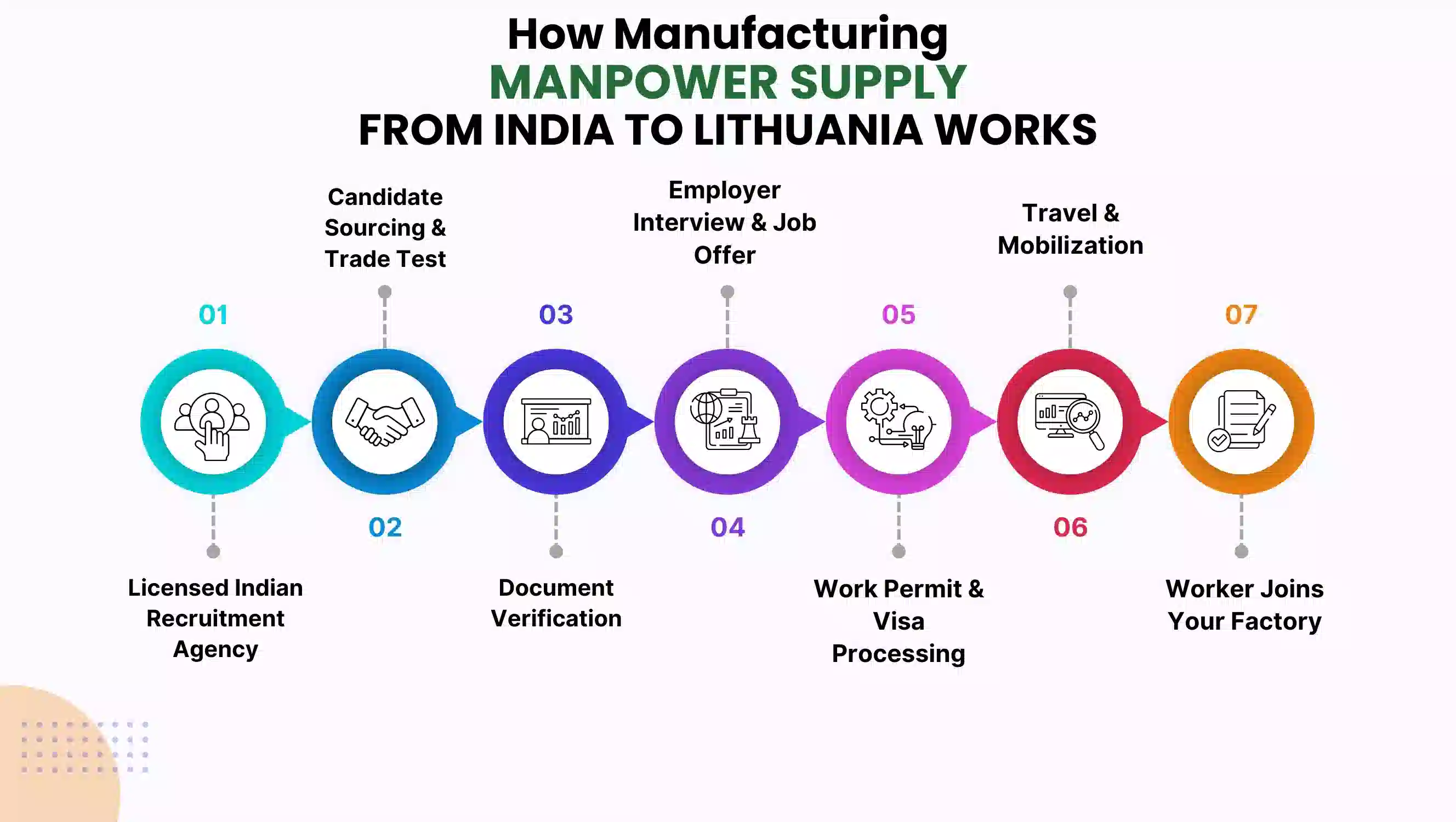
The process has six stages: define the role and salary, source and screen candidates in India, run the Lithuanian labor market test (unless exempt), submit the work permit application, have the candidate apply for their visa or residence permit at the embassy and register the worker with Sodra before their first day.
- 1. Define the vacancy - job title, salary (must meet or beat Lithuania's benchmarks, covered below) and whether it matches a shortage occupation.
- 2. Source candidates through a licensed Indian manpower agency, collecting proof of qualifications, prior experience and trade certifications.
- 3. Run the labor market test, if required - employers need to demonstrate that they were unable to find a suitable candidate within the EU, EEA and Switzerland before hiring a non-national by advertising the position for at least 5 working days at the local labor services. This step is skipped for shortage-list roles or high-salary positions.
- 4. Submit the work permit application to the Employment Service or a mediation letter/labor market needs decision to the Migration Department if you're going the temporary residence permit route.
- 5. Candidate applies for a national D visa or temporary residence permit at the Lithuanian embassy in India, submitting the job offer, qualification proof, accommodation details and health insurance.
- 6. Register the worker with Sodra (social security) through the EDAS e-system - no later than 1 business day before the start of the employee's work in Lithuania. Only after this can the employee legally start.
Each of these six steps requires careful documentation and coordination. If you're looking for expert assistance with hiring skilled manufacturing workers from India, contact Voltech HR Services to discuss your recruitment requirements.
How do I find a recruitment agency in India that supplies workers to Lithuania?
Look for an Indian agency registered under India's Emigration Act with the Protector of Emigrants - a mandatory license for recruiting blue-collar workers for overseas jobs and confirm it has documented placements in EU manufacturing roles, not just Gulf-country postings. Ask for the names of at least two Lithuanian employers the agency has placed workers with in the last 12 months and verify those references directly yourself.
There is currently no government-to-government labor mobility agreement between India and Lithuania (India has separate formal agreements with Russia and Israel for this purpose), so your agency is operating under standard private recruitment rules, not a treaty framework. That makes due diligence on the agency itself - not just the candidates - your biggest risk-reduction step. A reliable agency handles document translation and legalization, coordinates directly with your Lithuanian HR/immigration contact on the permit paperwork and never asks the worker to pay the Lithuanian work permit fee, since the fees for a work permit are paid by the employer, so if someone asks the worker to pay for it, there's a good chance the permit isn't real.
Is it legal to hire manufacturing workers from India to work in Lithuania?
Yes. Hiring Indian nationals for manufacturing roles in Lithuania is fully legal, provided you go through the standard third-country national work authorization process - there is no restriction specific to Indian citizens. Employers should assess each candidate's specific circumstances to determine the necessity of a work permit, since most manufacturing hires from India will need one, but the legal pathway itself is open to any non-EU/EEA/Swiss nationality, including India.
What makes a hire illegal is skipping the process - for example, bringing a worker in on a tourist Schengen visa and having them start work or letting a candidate work while their application is still pending. Both carry fines for the employer and can block future permit applications for years.
What work permit and visa do Indian workers need to work in a Lithuanian factory?
Most Indian manufacturing hires need either (a) a work permit plus a national D visa, valid for up to one year or (b) a temporary residence permit for employment, valid for up to two years and renewable, which is now the more common route for standard factory roles.
Authorization types:
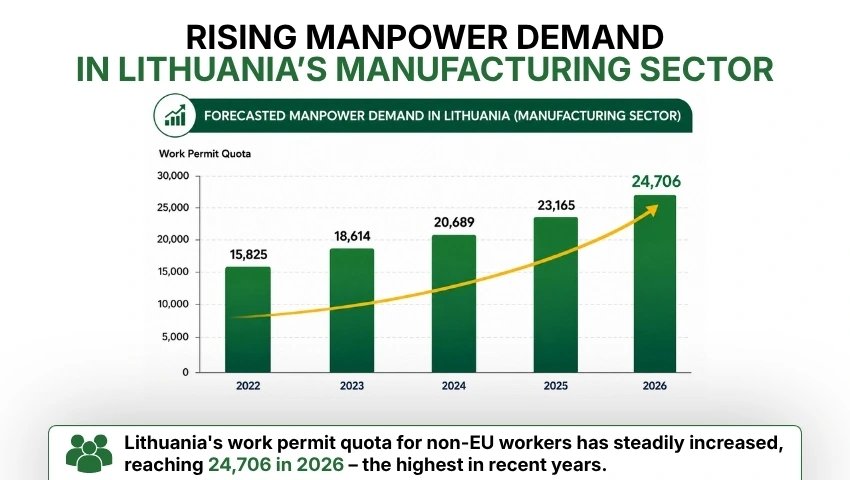
The New Quota System, introduced in 2025, places an annual cap on residence permits for non-highly qualified third-country nationals and for 2026 that cap sits at 24,706 quotas. Once it's exhausted, you can still get a permit approved outside the quota if the worker's salary is at least 1.2 times the average monthly gross salary (currently €2,893.68) or at least the average wage (€2,411.40) with the profession on the shortage-in-Lithuania list.
How Long Does It Take to Hire Manufacturing Workers from India for Lithuania?
Realistically, 8 to 14 weeks from signed job offer to the worker's first day on the factory floor, assuming no quota bottleneck and complete documentation on the first submission.
The biggest timeline risk isn't the Lithuanian side - it's incomplete or unlegalized documents from India (educational certificates, trade test results, police clearance) bouncing the application back for resubmission. Build in a buffer for this before you commit to a production start date.
How Can I Verify the Skills of Manufacturing Workers from India Before Hiring?
Verify skills through a documented trade test (video-recorded, ideally conducted by a third-party skill assessment body), attested educational/ITI (Industrial Training Institute) certificates and a reference check with the candidate's previous Indian or overseas employer - don't rely on the recruitment agency's own assessment alone.
For roles like welders, CNC operators and machine tool setters, ask the agency to arrange a practical skill test against a defined standard (for example, welding position and material tests, or a timed CNC programming/operation task) and share the recorded results before you extend an offer. Cross-check certificates against India's National Council for Vocational Training (NCVT) or Sector Skill Council registries, since certificate fraud is the most common cause of skills mismatch after arrival - a risk documented in other India-outbound labor corridors, where an investigation found instances of skills mismatches after workers were sent abroad through formal channels, including a man recruited as a mason who was made to work as a cleaner.
Why are Lithuanian Manufacturers Hiring Skilled Workers from India?
Lithuanian manufacturers are widening their sourcing beyond the traditional Belarusian and Ukrainian talent pool because those corridors are shrinking or politically constrained and India offers scale, English-language administrative documentation and a large ITI-trained technical workforce. Belarusian, Ukrainian, Uzbek, Tajik and Kyrgyz nationals currently make up the largest shares of Lithuania's roughly 106,000 employment-based residence permit holders, but manufacturers report the shortage list keeps growing regardless. Foreign workers in Lithuania rose 18.3% in a single year, reaching 150,500, with 138,300 coming from 132 non-EU countries - meaning India is one option among a diversifying set of source countries, not yet a dominant one, which is exactly why early movers face less competition for candidates.
What Manufacturing Roles Can Indian Workers Fill in Lithuania?
Indian workers can fill roles across food processing, metalworking, woodworking/furniture and machine operation - the specific categories Lithuania's own labor authority reports as chronically short-staffed. Manufacturing companies report demand for tailors, metal working machine tool setters and operators, bakers, carpenters, lifting truck operators, food and related products machine operators, furniture makers, production engineers and welders. Lithuania's manufacturing sector accounts for over 20% of GDP, driven by automotive, electronics and metal production and needs more mechanical and electrical engineers, production managers and CNC machine operators.
Why are Lithuanian Manufacturers Hiring Skilled Workers from India?
Lithuanian manufacturers are expanding their recruitment efforts beyond traditional labour markets such as Belarus and Ukraine due to ongoing workforce shortages and changing geopolitical conditions. As the demand for skilled manufacturing workers continues to grow, employers are increasingly exploring new talent sources, including India.
India has become an attractive recruitment destination because of its large pool of technically trained workers, strong manufacturing workforce and English-language documentation that simplifies the hiring process. Many Indian candidates also hold vocational qualifications from Industrial Training Institutes (ITIs) and have experience in manufacturing, fabrication, machining and production operations.
Although workers from Belarus, Ukraine, Uzbekistan, Tajikistan and Kyrgyzstan still represent the largest share of Lithuania's employment-based residence permit holders, labour shortages across the manufacturing sector continue to increase. As a result, Lithuanian employers are actively diversifying their international recruitment strategies.
According to recent workforce data, the number of foreign workers in Lithuania increased by 18.3% in a single year, reaching approximately 150,500 employees, with around 138,300 coming from 132 non-EU countries. This highlights Lithuania's growing reliance on international talent to address workforce shortages.
While India is not yet the largest source of manufacturing workers for Lithuania, it is becoming an increasingly important talent market. For employers, this creates an opportunity to access a large pool of skilled manufacturing professionals before competition for Indian workers becomes even stronger.
What manufacturing Jobs can Indian Workers fill in Lithuania?
Indian workers can fill roles across food processing, metalworking, woodworking/furniture and machine operation - the specific categories Lithuania's own labor authority reports as chronically short-staffed. Manufacturing companies report demand for tailors, metal working machine tool setters and operators, bakers, carpenters, lifting truck operators, food and related products machine operators, furniture makers, production engineers and welders. Lithuania's manufacturing sector accounts for over 20% of GDP, driven by automotive, electronics and metal production and needs more mechanical and electrical engineers, production managers and CNC machine operators.
For 2026, 100 new shortage occupations were added, particularly opening doors in emerging sectors like renewable energy and advanced manufacturing, on top of an already broad list - a strong signal that hiring from India into these specific job titles is likely to bypass the quota queue rather than compete for it.
Ready to Hire Skilled Manufacturing Workers from India for Lithuania?
Hiring manufacturing workers from India is a practical solution for Lithuania's manufacturing labour shortage. Success depends on partnering with a licensed Indian recruitment agency for Lithuania , recruiting workers for roles listed on Lithuania's 2026 shortage occupation list and planning for a realistic 10 - 12 week recruitment and onboarding timeline.
Frequently Asked Questions About Hiring Manufacturing Workers from India for Lithuania
Q1. Can Lithuanian companies legally hire manufacturing workers from India?
Yes. Lithuanian employers can legally hire Indian manufacturing workers through the standard work permit and visa process, provided all employment and immigration requirements are met.
Q2. How long does it take to hire manufacturing workers from India for Lithuania?
Most employers can expect the hiring process to take 10 - 12 weeks, depending on documentation, work permit approval and visa processing times.
Q3. Do Indian manufacturing workers need a work permit for Lithuania?
Yes. Most Indian workers require a Lithuanian work permit along with a National D visa or a temporary residence permit before starting employment.
Q4. Which manufacturing jobs are in demand in Lithuania?
Lithuania has strong demand for welders, CNC operators, machine operators, assemblers, production workers, electricians, carpenters and food processing workers.
Q5. Can a recruitment agency in India supply workers for Lithuania?
Yes. A licensed Indian recruitment agency can source, screen, verify and mobilize skilled manufacturing workers while supporting employers with documentation.
Q6. How much does it cost to hire manufacturing workers from India?
Hiring costs vary based on recruitment, permits, travel and mobilization. Government permit fees are separate from recruitment and relocation expenses.
Q7. Why should I choose a licensed Indian recruitment agency for Lithuania?
A licensed agency helps ensure compliant recruitment, verified candidates, accurate documentation and smoother work permit processing, reducing hiring delays.
Related Resources for Overseas Recruitment
Planning to hire manpower from India for your operations outside Lithuania too? Explore our in-depth guides on overseas recruitment strategy and compliance:
→ Why European Companies Need Indian Talent in Future Recruitment - Europe's manufacturing and industrial sectors are facing a widening skills gap as local workforces age and shrink. Learn why more European employers are turning to India's technically trained talent pool and what this shift means for your long-term hiring strategy.
→ Skills-First Hiring for Overseas Recruitment Success - Hiring on paper qualifications alone increases the risk of mismatched placements and costly turnover. Discover how a skills-first approach - built on practical trade testing and verified competency - leads to better retention and productivity for overseas hires.
→ How to Legally Hire Workers from India for the Philippines and Germany - Every country has its own work permit rules, quotas and documentation requirements for hiring non-local talent. Get a clear breakdown of the legal pathways for sourcing manpower from India into the Philippines and Germany, so your hiring stays fully compliant from day one.
About the Author:
I'm Srisivam Selvarajan and I've spent over 13 years in sales and marketing across Saudi Arabia's building materials, steel and HVAC industries. I started on the ground - literally selling door to door - before working my way into roles where I saw firsthand what makes industrial organizations grow and just as often, what holds them back: the right people not being available when they're needed.
That gap is what led us to build this Lithuania Blog and our Website Page. Manufacturers we work with kept asking the same question in different words - where do we find skilled workers when the local pool runs dry - so at Voltech HR Services, we built a dedicated resource for exactly that problem: connecting Lithuanian manufacturers with verified, work-ready manpower from India.
Ready to Fill Your Manufacturing Workforce Gap?
Voltech HR Services sources, verifies and mobilizes manufacturing workers from India for Lithuanian manufacturers - handling agency licensing checks, trade testing and Lithuanian work permit coordination as one process instead of three separate headaches.
www.voltechhrservices.comIndia to Lithuania Recruitment | Licensed Recruitment Agency | Manufacturing Manpower | Skilled Worker Sourcing | End-to-End Hiring Support
Write Comment