
-
 Call: +91-9840269190
-
 Mail: hr@voltechgroup.com

When does Managing Contract Workers internally become more Expensive than Outsourcing?

When Does Managing Contract Workers internally become more Expensive than Outsourcing?
- Published: [16.10.2026]
- Updated: [16.10.2026]
Managing contract workers in-house becomes more expensive than outsourcing when the combined cost of HR and supervisor time, attendance and invoice corrections, onboarding, replacement coordination, systems and operational delays exceeds a provider's fee for the same scope. There is no universal headcount threshold. The answer depends on your scope, workforce complexity and internal capacity.
Outsourcing is not automatically cheaper. Compare the same workforce, service levels, responsibilities and exclusions before you decide. This guide shows you how.
In this guide: what in-house management involves, how to cost it, what outsourcing includes, a step-by-step cost comparison method, trigger signs with a quick self-assessment, when in-house is better, what you still own under India's Labour Codes and how to compare providers.
What Does Managing Contract Workers Internally Involve?
Most businesses underestimate this because the work is spread across many people and never appears as one budget line. Managing a contract workforce in-house typically includes:
Be Clear About Your Model First
Four terms are often confused:
| Term | What It Means |
|---|---|
| In-house management | You engage and administer contract workers yourself, including records, attendance and coordination. |
| Contract staffing | A staffing provider supplies workers and manages defined parts of their engagement, administration and replacement, under a written agreement. |
| Payroll outsourcing | A provider only processes pay for people you already engage. It does not supply or manage the workforce. |
| Direct hiring | You employ the worker yourself on your own payroll. |
If you only need payroll processing, you are comparing a different decision from the one in this guide.
What Is the Real Cost of Managing Contract Workers In-House?
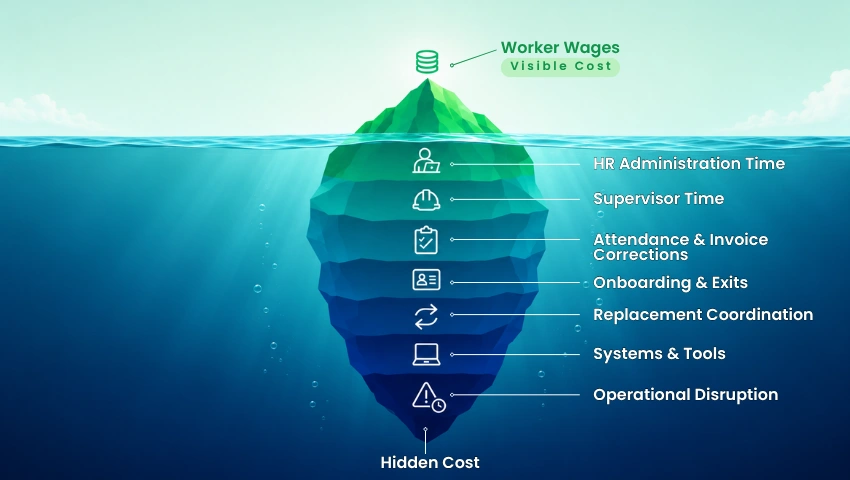
The cost is rarely the worker's wage. It is the administration and disruption around the worker. Step 2 below lists every category and where to find the data. In short, count HR and supervisor time, systems, onboarding and exits, attendance and invoice corrections, replacement coordination and as an optional scenario, operational disruption.
Measure, don't guess. Take a two-to-four-week time sample. Ask HR, supervisors and finance to log minutes spent on contract workforce tasks. A rough sample beats an estimate from memory.
Run Your Own Two-Week Time Sample
Ask HR, supervisors and finance to log every contract workforce task for 10 working days. Use one row per task block (not one row per employee or per day) and repeat rows as often as needed. Record actual minutes, the site or shift and whether the work arose from a correction or replacement. At the end, total the minutes by category, divide by 60 to get hours and carry the hours into Step 2 below.
| Date | Role | Activity Category | Minutes | Site / Shift | Linked to a Correction or Replacement? |
|---|---|---|---|---|---|
| HR | Attendance capture or correction | ||||
| HR | Onboarding or exit paperwork | ||||
| Supervisor | Replacement calls and rescheduling | ||||
| Finance | Invoice matching | ||||
| HR | Records and register updates | ||||
| HR | Audit or report preparation | ||||
What Does Outsourcing Contract Workforce Management Include?
This depends entirely on the agreement. Never assume. Typical services a contract staffing provider may offer include sourcing and deploying workers, onboarding, attendance tracking, replacement of absent workers, payroll processing and statutory compliance administration for workers they engage and periodic reporting.
What to separate when reading a quote:
A low headline fee with many exclusions can cost more than a higher fee with a broader scope. That is why a like-for-like comparison matters.
How to Calculate In-House vs Outsourcing Costs for Contract Workers
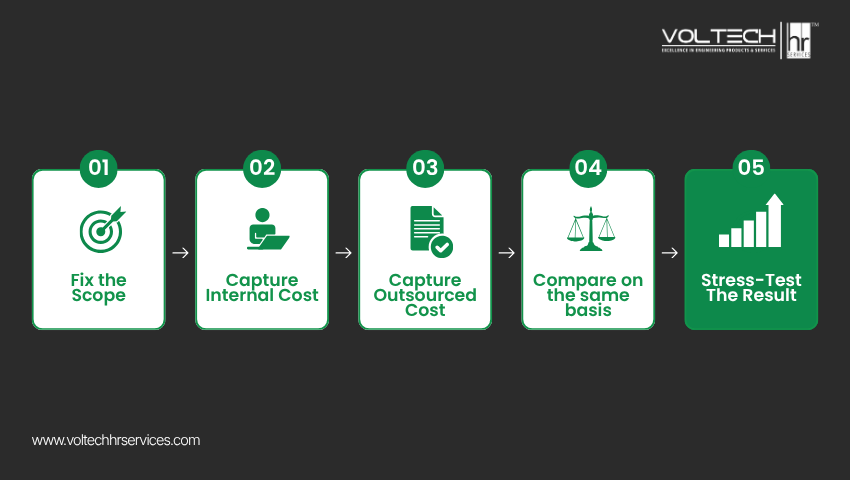
You can compare the two models fairly without quoting a single market average. You need your own data, a written quote for a defined scope and a method that keeps both sides equal.
This guide deliberately shows no sample prices, savings percentages or per-worker averages. The result depends on your sites, roles, shifts, absence patterns and the actual quotation. Any figure we invented would mislead you.
Step 1: Fix the Scope
Write down the workforce you are comparing before you collect any cost.
Step 2: Capture Your Internal Cost From Your Own Records
| Cost Item | Where the Data Comes From | Quality Check |
|---|---|---|
| HR or workforce administrator time | Time sample over 2 to 4 weeks | Use logged minutes, not memory |
| Supervisor and operations time | Supervisor time log for absences, attendance and replacement issues | Do not repeat hours already counted under HR |
| Systems and tools | Finance records for relevant software, devices and access | Allocate only the share used for this workforce |
| Onboarding and exits | Count of starts and exits multiplied by logged effort per event | Keep recruitment fees separate from administration |
| Attendance and invoice corrections | Correction log for a defined sample period | Count each correction once |
| Replacement coordination | Replacement log: hours and direct costs | Do not count the same vacancy impact twice |
| Operational disruption (optional) | Records of unfilled shifts, overtime and delayed output | Show your assumptions and a low, base and high case |
Use the loaded hourly cost of each person (salary plus benefits and overhead) from your finance team. Exclude worker wages and statutory contributions if you pay them in both models.
Step 3: Capture the Outsourced Cost From a Written Quote
| Cost Item | Where the Data Comes From | Quality Check |
|---|---|---|
| Provider fee | Written quotation for your exact scope and headcount | Confirm the fee basis: percentage, per head or hybrid |
| Minimums and add-ons | Quotation terms and annexures | Record minimum headcount, billing floors and optional charges |
| Exclusions | Scope clauses in the draft agreement | List every task the provider does not perform |
| Client-side work that remains | Your own time log for approvals, supervision, safety coordination and audits | Outsourcing does not mean zero internal effort |
| Transition and exit cost | Provider and internal estimates for data handover, overlap and contract exit | Keep one-time costs separate and spread them over a stated period |
| Residual disruption | Service-level terms and your own absence history | Link any assumption to the replacement SLA in the agreement |
Get at least two quotes for the same scope. If the scopes differ, adjust them to match before you compare.
Step 4: Compare on the Same Basis
Divide each total by the number of deployed workers or shifts to get a cost per worker or per shift. Compare identical scope and service levels and show one-time transition costs separately from recurring monthly costs.
Step 5: Stress-Test the Result
Run a low, base and high case using your own data. Vary the inputs that move the answer most:
How to Read the Result
| If Your Comparison Shows | What It Suggests | What to Do Next |
|---|---|---|
| Outsourcing is clearly lower across low, base and high cases | A strong cost case, subject to scope and service levels | Pilot with one site or group and track against your baseline |
| The two are close | Cost alone will not decide it | Weigh control, compliance evidence, capacity, flexibility and risk |
| In-house is clearly lower across cases | Your internal process may already be efficient | Keep it in-house, or revisit if workload or absence patterns change |
The break-even point is different for every business. It moves with your internal workload, your absence and replacement patterns and the scope and fee in the actual quote. A claim that outsourcing always saves money, or that it never does, is not backed by your own numbers. Use the Step 2 and Step 3 tables above as your cost comparison worksheet, filled in with your own figures only.
When Does Outsourcing Become Worth Considering?
Use trigger conditions rather than a made-up employee count. Outsourcing may be worth a serious look when you see several of these:
The last sign is often the most telling. If you cannot say what the current model costs, you cannot judge a provider's quote.
Signs You Have Outgrown Your Internal Process
| Warning Sign | What It Usually Means |
|---|---|
| Month-end invoice disputes are routine | No reliable attendance evidence shared with the provider or finance |
| Replacement takes more than one shift | No standing pool or response process |
| Different sites keep different records | No standard workflow |
| Only one person knows how the process works | Key-person risk |
| Audit preparation takes days | Records not maintained continuously |
Quick Self-Assessment: Should You Request Quotes?
Count every statement that is true for your business today.
When Might In-House Management Be Better?
Outsourcing is not right for every business. Keeping management in-house may fit better when:
A hybrid model is also valid. You might keep supervision, selection and approvals internally while a provider handles sourcing, onboarding, attendance records and replacement. Define who owns each task in writing.
What Responsibilities Remain With the Client?
Outsourcing shifts administration. It does not automatically remove the client's legal and operational obligations. Under India's Labour Codes, the principal employer keeps several duties even when a provider runs the workforce. The sections below summarise them with sources.
| Area | Typically With the Provider | Typically Remains With the Client |
|---|---|---|
| Sourcing and deployment | Recruiting, screening, deploying workers | Defining roles, numbers and quality criteria |
| Onboarding | Document collection, joining formalities | Site induction, safety training and access control |
| Attendance | Maintaining records as agreed | Verifying and approving attendance and overtime |
| Wages and payroll | Processing wages for workers they engage | Supplying accurate approved inputs; confirming wages are paid |
| Statutory compliance | Registrations, returns and contributions in their scope | Verifying evidence; obligations that law places on the principal employer |
| Safety | Their own policies and worker briefing | Safe workplace, equipment and on-site supervision |
| Records | Provider-side registers and files | Registers and records the client must keep; audit access |
| Issue handling | Replacement, grievance routing | Escalation decisions and corrective action |
Three practical rules:
What the Labour Codes Mean for the Principal Employer
India's four Labour Codes took effect on 21 November 2025 and replaced 29 earlier central labour laws, including the Contract Labour (Regulation and Abolition) Act, 1970. Final central rules under the Codes were notified in May 2026 (KPMG, Lakshmikumaran & Sridharan). Law-firm summaries point to these areas for principal employers:
Records to Keep Available
Confirm the exact registers, forms and retention periods under the rules that apply to your establishment. As a working checklist, keep these ready for an audit:
How State Differences Affect Your Decision
For how Voltech handles statutory obligations for the workers it engages, see our staffing and payroll services in India.
How to Compare Staffing Providers
Quotations with different fee structures are hard to compare. Normalise them using the same headcount, shifts, roles and service levels.
Provider Comparison Checklist
Documents and Reports a Provider Should Supply Each Month
Key Performance Indicators to Track
| KPI | Why It Matters |
|---|---|
| Fill rate (positions filled ÷ positions requested) | Measures coverage |
| Replacement turnaround | Measures responsiveness |
| Attendance reconciliation variance | Measures record accuracy |
| Invoice dispute rate | Measures billing quality |
| Worker turnover | Measures retention and fit |
| Compliance document completeness | Measures audit readiness |
Warning Signs of a Provider Not Delivering Value
How to Move From In-House to a Provider
Transition well and you avoid the disruption that makes people regret outsourcing.
Frequently Asked Questions About Contract Workforce Management
Q1. At what workforce size should a company consider outsourcing contract staffing?
There is no reliable universal threshold. Consider the signs instead: recurring admin bottlenecks, multiple sites or shifts, slow replacements, inconsistent records or insufficient internal capacity. Test your own numbers using the cost comparison steps above.
Q2. Is contract staffing more expensive than hiring workers directly?
It depends on how long you need the workers, how much flexibility you need and how much administration you can absorb. Direct hiring can suit stable, long-term roles that your team can administer well. Contract staffing can suit variable demand, short or uncertain durations and teams without capacity to run onboarding, attendance and compliance administration. To compare fairly, include wages, statutory costs, administration, the value of flexibility and exit costs for your specific roles and duration.
Q3. What is included in a contract staffing service fee?
It varies. Ask for a written scope that lists sourcing, onboarding, attendance, payroll, compliance and replacement services and separately lists exclusions and add-on charges.
Q4. What is the difference between contract staffing and payroll outsourcing?
Contract staffing involves a provider supplying and managing workers. Payroll outsourcing only processes pay for people you already engage.
Q5. Who is responsible for wages and statutory compliance for contract workers?
Responsibility is divided between the provider and the principal employer according to law and the agreement. The client may retain obligations, so verify with a qualified professional against current rules.
Q6. What should I do if the provider's attendance records differ from ours?
Set a written reconciliation process: agree the source of truth, compare daily records, document the difference, correct it before invoicing and track disputes as a KPI.
Q7. Can I use a hybrid model?
Yes. Many businesses keep supervision and approvals internally while a provider handles sourcing, onboarding and records. Write down who owns each task.
Q8. What should I review before renewing a staffing agreement?
Review KPIs against SLAs, invoice accuracy, compliance evidence, replacement performance, fee changes and whether the scope still matches your needs.
Related Resources for Employers & HR Leaders
Looking to strengthen your workforce planning? Explore our related pages:
→ Staffing & Payroll Services in India - See how Voltech supports contract staffing, payroll management and statutory compliance administration.
→ Recruitment Agency in India for Businesses - Explore Voltech's domestic recruitment service for permanent white-collar hiring.
Next Step
Before you ask anyone for a quote, find out what your current model costs. The time sample and the Step 2 and Step 3 tables above help you capture internal time, corrections, replacements and disruption, so you can compare like with like.
If you share your approximate headcount, location, industry, roles, shift pattern, expected duration and current pain point, we can discuss a defined requirement. We do not promise savings before assessing your workforce and service scope.
Muthamizh Tikkaraman
Muthamizh Tikkaraman has over 5 years of experience in HR, staffing and payroll, including 1 year at Voltech HR Services. She takes part in industry events and follows market trends to understand changing business needs and workforce challenges. Her practical observations and market research help shape content that shares useful insights on staffing, payroll and workforce management.
View LinkedIn Profile →
Write Comment