
-
 Call: +91-9840269190
-
 Mail: hr@voltechgroup.com

Labour Compliance in India 2026: EPF, ESI, Gratuity & Labour Code Checklist

Key Labour Compliance Requirements for Businesses in India (Updated 2026)
- By Muthamizh.P
- Published: 11 June 2026
- Updated: 1 October 2026
- Reading time: 14 min
- Written by Muthamizh.P , I've been working in HR operations, payroll administration and statutory compliance for over 5 years. Through my work, I regularly interact with HR leaders, payroll professionals, compliance experts and business owners to understand the real-world challenges organizations face in managing payroll and labor law compliance across India. The insights shared in this article are based on those conversations, industry developments and practical experience with payroll processes, compliance requirements and workforce management. My goal is to help employers and HR professionals better understand complex compliance topics and make informed decisions when managing or outsourcing payroll.
Key Takeaways:
- •The 4 Labour Codes replaced 29 central laws from 21 November 2025. States notify their rules separately, so confirm your state's status.
- •EPF: 12% employee + 12% employer on wages up to the ₹15,000 ceiling (higher if the employer opts), mandatory for 20+ employees.
- •ESI: 0.75% employee + 3.25% employer on gross wages, for employees earning up to ₹21,000 a month.
- •50% wage rule: basic + DA must be at least 50% of total pay, which raises PF and gratuity cost.
- •Fixed-term employees become gratuity-eligible after 1 year of service.
- •Principal employers stay liable for contractor defaults, and directors can face personal prosecution for wilful default.
Labour compliance is not optional for businesses operating in India. It is a legal obligation backed by monetary fines, criminal liability and operational shutdown risk. Every business, from a 10-person startup to a 10,000-employee enterprise, must understand and act on these requirements.
This guide is written for business owners, HR managers, payroll teams and operations heads. Each section opens with a direct answer, then gives the thresholds, rates, worked examples, deadlines and penalties you need. If you would rather hand the work to specialists, see our staffing and payroll compliance services or read how outsourcing payroll affects your statutory liability.
- What is labour compliance in India?
- The 4 Labour Codes
- Compliance thresholds by headcount
- Registrations every employer needs
- EPF compliance
- ESI compliance
- Gratuity rules
- The 50% wage rule explained with an example
- Minimum wages and bonus
- Working hours, safety and welfare
- Contract labour and staffing
- Gig and platform workers
- Statutory registers and records
- Compliance calendar
- Penalties
- Inspection readiness
- In-house vs outsourced compliance
- Common mistakes
- FAQs
What is labour compliance in India?
Compliance is enforced by several bodies. The Ministry of Labour & Employment frames the Codes, the Employees’ Provident Fund Organisation (EPFO) and Employees’ State Insurance Corporation (ESIC) administer social security, state labour departments handle shops and establishments, professional tax and welfare funds, and inspectors check records on site.
The cost of getting it wrong is rarely a single fine. Late deposits add interest and damages, missing records trigger notices, and a contractor default can land on the principal employer. For businesses that also hire at scale, compliance connects directly to recruitment and onboarding, because appointment letters, identity checks and registrations start on the first day of employment.
What are the 4 new Labour Codes every business in India must follow?
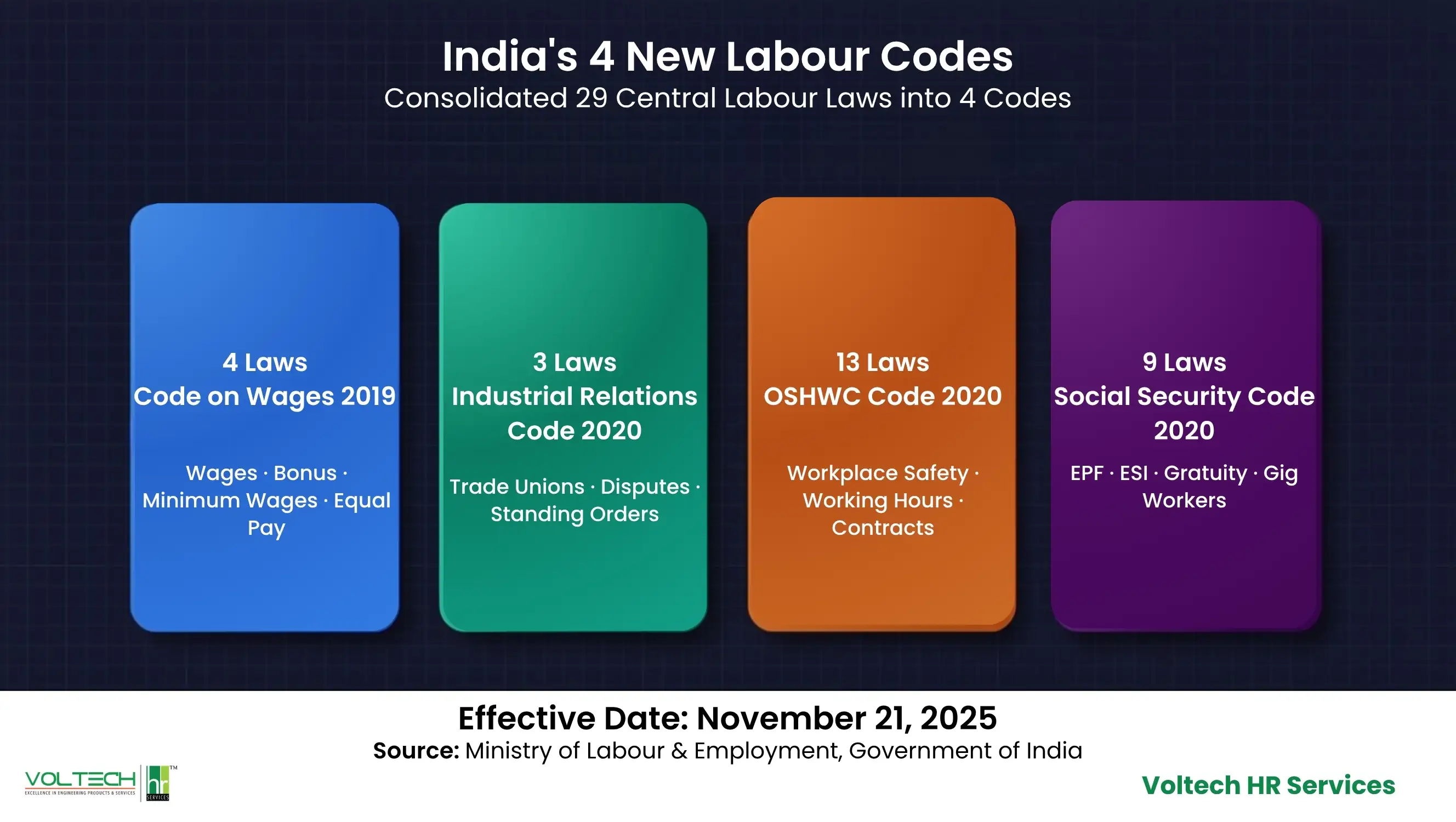
The Ministry of Labour & Employment consolidated the older Acts into four Codes. States notify their own rules under the Codes, so the exact forms and thresholds can differ by state. Source: Ministry of Labour & Employment, Government of India.
| Labour Code | Replaces (No. of Laws) | Core Subject | Primary Obligation |
|---|---|---|---|
| Code on Wages, 2019 | 4 laws | Wages, Minimum Wages, Bonus, Equal Remuneration | Basic + DA must be at least 50% of total remuneration |
| Code on Industrial Relations, 2020 | 3 laws | Trade Unions, Industrial Disputes, Standing Orders | Standing orders for 300+ worker establishments |
| Occupational Safety, Health & Working Conditions (OSHWC) Code, 2020 | 13 laws | Workplace Safety, Working Hours, Contracts | Written appointment letters for all workers |
| Code on Social Security, 2020 | 9 laws | EPF, ESI, Gratuity, Maternity, Gig Workers | Single registration; gig/platform worker coverage |
What has changed for employers under the new Labour Codes in India?
Since 21 November 2025, employers file one registration and one return instead of many, follow a common definition of wages that affects PF and gratuity, issue written appointment letters to all workers, give fixed-term employees gratuity after 1 year, cover gig workers under social security, and may keep records digitally.
The key changes at a glance:
- •One registration and one return replace multiple registrations and returns under separate Acts.
- •A uniform definition of wages applies across the Codes, which links salary design to PF, gratuity and bonus.
- •Written appointment letters are required for all workers, including contract and daily-wage workers.
- •Fixed-term employment is formally recognised, with gratuity after 1 year of service.
- •Gig and platform workers are covered by social security for the first time.
- •Digital records and returns are permitted, which reduces paperwork but increases the need for accurate payroll data.
Which labour compliances apply to your business? Thresholds by headcount
| Trigger | What applies |
|---|---|
| 10+ employees | ESI (20+ in some states); gratuity applicability; internal committee under the POSH Act |
| 20+ employees | EPF registration; Payment of Bonus |
| 50+ employees | Crèche facility (as notified) |
| 50+ contract workers | Principal employer registration and contractor licence under the OSHWC Code |
| 300+ workers | Standing orders under the Industrial Relations Code |
| 500+ workers | Safety committee |
Compliance priorities by stage of growth
| Headcount | Start with | Add as you grow |
|---|---|---|
| 1 to 9 | Shops & Establishment registration, appointment letters, minimum wages, professional tax where applicable | Payroll software and a leave and attendance record |
| 10 to 19 | ESI, gratuity provision, POSH internal committee | Statutory registers in digital format |
| 20 to 49 | EPF registration, bonus, monthly ECR and challan routine | Salary structure review for the 50% wage rule |
| 50 to 299 | Crèche (as notified), contractor compliance checks, welfare facilities | Compliance calendar and internal audit |
| 300+ | Standing orders, formal grievance and safety systems | Dedicated compliance owner or outsourced partner |
Which registrations does an employer need in India?
| Registration | Applies when | Where it is handled |
|---|---|---|
| Shops & Establishment / Factory registration | Any commercial establishment or factory | State labour department |
| EPF registration | 20+ employees (voluntary below that) | EPFO portal |
| ESI registration | 10+ employees (20+ in some states) with covered wages | ESIC portal |
| Professional Tax enrolment and registration | Employer and employees in states that levy PT | State commercial tax or labour department |
| Labour Welfare Fund | States that have notified a fund | State labour welfare board |
| Contractor licence / principal employer registration | Contract workers above the notified threshold | Licensing officer under the OSHWC Code |
| POSH Internal Committee | 10+ employees | Constituted internally; annual report to the district officer |
For employers building a new workforce, registrations should be done before the first payroll. Our staffing and payroll team handles registrations alongside salary processing so the first month’s filings are not missed.
What is the Employees Provident Fund (EPF) compliance requirement for Indian businesses?
The Employees Provident Fund (EPF) is a mandatory retirement savings scheme. Smaller establishments can register voluntarily. Employees whose basic + DA is above ₹15,000 are still covered, and contributions can be on the ₹15,000 ceiling or on actual wages, depending on the employer’s policy and the employee’s option.
EPF contribution rates
| Contributor | Rate | Split / Notes |
|---|---|---|
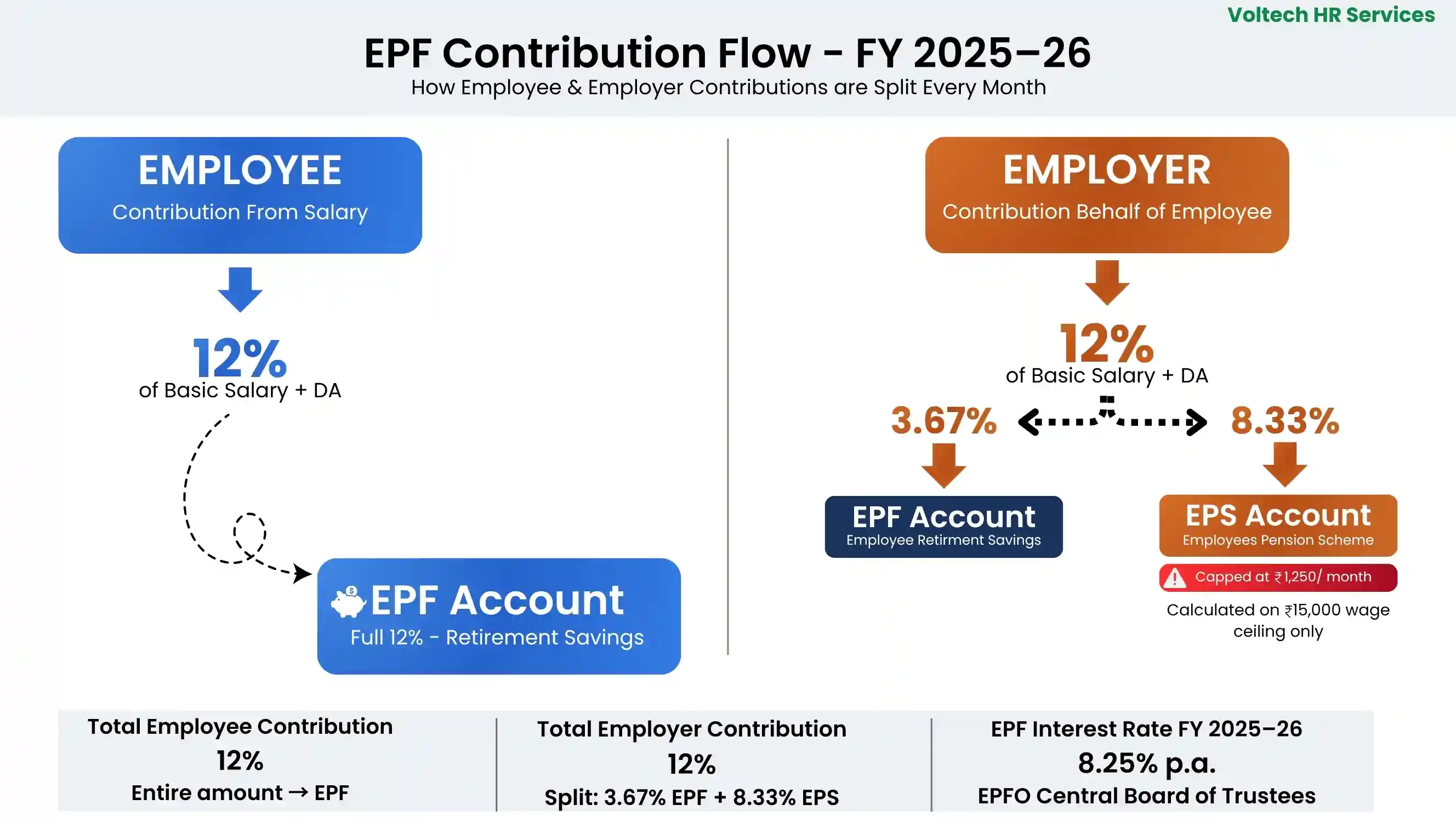
| Employee | 12% of Basic Salary + DA | Entire 12% goes into the EPF account |
| Employer - EPF portion | 3.67% of Basic Salary + DA | Goes into the EPF (savings) account |
| Employer - EPS portion | 8.33% of Basic Salary + DA | Goes into the Employees' Pension Scheme; capped at ₹1,250/month on the ₹15,000 wage ceiling |
| Total Employer Contribution | 12% of Basic Salary + DA | Split between EPS (8.33%) and EPF (3.67%) |
| Employer administration charges | 0.50% of wages (minimum ₹500 per month) | Payable by the employer in addition to the 12%; confirm current charges on the EPFO site |
| EDLI contribution | 0.50% of wages (up to the ceiling) | Employer-paid insurance linked to the provident fund |
| EPF Interest Rate | 8.25% per annum (FY 2024-25) | Notified yearly by the EPFO Central Board of Trustees. Check the EPFO website for the current rate. |
Worked example: EPF on ₹30,000 basic + DA
| Item | Amount per month |
|---|---|
| Employee contribution (12% of ₹30,000) | ₹3,600 |
| Employer contribution (12% of ₹30,000) | ₹3,600 |
| Of which EPS (8.33% of ₹15,000 ceiling) | ₹1,250 |
| Of which EPF (balance of employer share) | ₹2,350 |
| Total credited to the employee’s EPF account | ₹3,600 + ₹2,350 = ₹5,950 |
What is the due date for EPF payment every month in India?
EPF contributions and the ECR (Electronic Challan-cum-Return) must be deposited and filed by the 15th of the following month. For example, contributions for October 2026 are due by 15 November 2026. Late payment attracts interest and damages.
EPF deadline checklist:
- •Monthly contribution deposit: by the 15th of the following month.
- •ECR (Electronic Challan-cum-Return) filing: through the EPFO portal along with the monthly deposit.
- •New joiners: UAN generation and KYC linking should be completed at onboarding so ECR does not fail.
EPF penalty for non-compliance
| Delay in deposit | Damages (per annum, on the amount due) |
|---|---|
| Less than 2 months | 5% |
| 2 months to under 4 months | 10% |
| 4 months to 6 months | 15% |
| More than 6 months | 25% |
Interest at 12% per annum is charged in addition to damages. Failure to deposit contributions can also attract a fine of up to ₹1,00,000, and wilful non-payment can lead to imprisonment under the Code on Social Security, 2020. Confirm current rates on the EPFO portal because provisions are being aligned to the Code.
What is ESI compliance and who must register for ESI in India?
Employees’ State Insurance (ESI) is a social security scheme that gives covered employees medical care, sickness, maternity, disability and dependant benefits. Source: Employees’ State Insurance Act, 1948.
What is the ESI wage limit and who is covered?
The ESI wage limit is ₹21,000 gross wages per month, or ₹25,000 for persons with disabilities. Employees earning above the limit are not covered.
- •Establishment size: 10 or more employees in most states (20 or more in some states).
- •Type of establishment: factories and notified establishments such as shops, hotels, restaurants, cinemas, road transport, newspaper establishments and private educational and medical institutions.
- •Employee wages: gross wages of ₹21,000 a month or less.
- •Registration: done on the ESIC portal, and every covered employee receives an insurance number.
How much ESI contribution do the employer and employee pay?
The employer pays 3.25% and the employee pays 0.75% of gross wages, a combined 4.00%. The employer deposits the full amount each month.
| Contributor | Rate | Wage Basis |
|---|---|---|
| Employee | 0.75% of gross wages | Applicable only if gross wages are ₹21,000/month or less (₹25,000 for employees with disabilities) |
| Employer | 3.25% of gross wages | Calculated on the employee's gross salary |
| Total ESI Contribution | 4.00% of gross wages | Combined employee + employer contribution |
How is ESI calculated? Worked example on ₹20,000 gross wages
For an employee with gross wages of ₹20,000, the employee contribution is ₹150 and the employer contribution is ₹650, so ₹800 is deposited for that month.
| Item | Amount per month |
|---|---|
| Employee contribution (0.75%) | ₹150 |
| Employer contribution (3.25%) | ₹650 |
| Total deposited | ₹800 |
What benefits does ESI cover for employees?
ESI covers medical treatment for the employee and dependants, sickness and maternity benefits, and cash benefits for disability or death caused by a work injury.
- •Medical care for the employee and dependants.
- •Sickness benefit for certified sickness.
- •Maternity benefit for insured women, alongside the 26 weeks of paid leave under the Maternity Benefit Act.
- •Disability benefit: up to 90% of wages in case of employment injury.
- •Dependants' benefit: 90% of wages to dependants if the employee dies from a work injury.
What is the ESI payment due date every month?
ESI contributions must be deposited by the 15th of the following month. Late payment attracts 12% simple interest per annum.
- •Contribution deposit: by the 15th of the following month.
- •Contribution periods run April to September and October to March; confirm any half-yearly return requirement on the ESIC portal.
- •Delayed contributions attract 12% simple interest per annum.
What are the gratuity compliance requirements for Indian employers after the new Labour Codes?
Gratuity rules changed under the Code on Social Security, 2020. The changes affect salary structure, eligibility and payout timelines.
Updated gratuity eligibility - effective 21 November 2025
| Employee Type | Old Rule (Pre-Nov 2025) | New Rule (Post-Nov 2025) |
|---|---|---|
| Regular Employees | Eligible after 5 years of continuous service | Same - 5 years of continuous service |
| Fixed-Term Contract Employees | Required 5 years - practically ineligible | Eligible after 1 year of service (pro-rata) |
| Death or Permanent Disability | 5-year rule waived | 5-year rule waived - immediate eligibility |
Gratuity calculation formula
Gratuity = (Last Drawn Wages ÷ 26) × 15 × Number of Years of Service
Worked example
An employee with last drawn wages (basic + DA) of ₹40,000 and 8 years of service receives (40,000 ÷ 26) × 15 × 8 = ₹1,84,615 (rounded). Under the 50% wage rule, a higher wage base directly increases this figure.
Gratuity payment key numbers
- •Maximum tax-exempt gratuity: ₹20 lakh.
- •Payment deadline: within 30 days of the amount becoming payable.
- •Delay penalty: simple interest at the rate notified by the Central Government (currently 10% per annum).
- •Employers should keep nomination records updated for every employee.
The 50% wage rule explained with an example
Many Indian salary structures keep basic at 30 to 40% of CTC and place the rest in HRA and special allowances. That design lowers PF and gratuity cost, but the Code now treats the excess as wages. Source: Code on Wages, 2019.
Example: CTC of ₹10,00,000 a year (₹83,333 a month)
| Item | Old structure (basic 30%) | Compliant structure (basic 50%) |
|---|---|---|
| Monthly basic + DA | ₹25,000 | ₹41,667 |
| PF at 12% if paid on actual basic | ₹3,000 | ₹5,000 |
| Gratuity accrual per year of service | ₹14,423 | ₹24,038 |
| Take-home effect | Higher in-hand pay | Lower in-hand pay (PF and tax effects) |
The wage base rises by about 67% in this example, which is why gratuity and provisions rise sharply. Employers should run a payroll-impact estimate before restructuring and communicate changes to employees in writing. Our payroll team supports this through a salary structure and compliance audit.
What are the minimum wages and Payment of Bonus compliance rules in India?
Under the Code on Wages, 2019, state minimum wages cannot fall below the central floor wage, and rates are revised at intervals not exceeding five years. Payment must be made in full, without deductions other than those authorised by law.
Payment of Bonus - compliance thresholds
| Criterion | Threshold / Rule |
|---|---|
| Firm size for bonus applicability | Establishments with 20 or more employees |
| Eligible employee salary ceiling | Monthly salary or wages up to ₹21,000 |
| Minimum days worked | At least 30 working days in the financial year |
| Calculation ceiling | Bonus is calculated on wages up to ₹7,000 or the minimum wage, whichever is higher |
| Minimum bonus payable | 8.33% of annual wages (or ₹100, whichever is higher) |
| Maximum bonus payable | 20% of annual wages, when allocable surplus permits |
| Payment deadline | Within 8 months of the financial year end |
What are the working-hour, safety and welfare requirements under India's labour laws?
The Occupational Safety, Health and Working Conditions (OSHWC) Code, 2020 replaces 13 earlier laws and introduces uniform workplace safety standards. Source: OSHWC Code, 2020.
What are the core OSHWC compliance requirements for employers in India?
The core OSHWC compliance requirements include providing written appointment letters, maintaining workplace safety committees where applicable, following prescribed working hours and overtime rules, providing health check-ups and crèche facilities where applicable, and maintaining records of workplace accidents.
- • Written appointment letters for all workers, including contract and daily-wage workers.
- • Safety committee in establishments with 500 or more workers.
- • Working hours: 8 hours per day and 48 hours per week. Overtime is paid at double the ordinary rate.
- • Free annual health check-up for workers above 45 years of age (as notified).
- • Crèche facility in establishments with 50 or more employees (as notified).
- • Accident register and reporting of workplace accidents.
Other workplace obligations employers often miss
- • Maternity benefit: 26 weeks of paid leave for the first two children and 12 weeks thereafter.
- • POSH: an Internal Committee for establishments with 10 or more employees, with an annual report.
- • Equal remuneration: no gender discrimination in wages for the same work.
- • Professional Tax: capped at ₹2,500 per employee per year; frequency varies by state (for example, some states collect half-yearly).
OSHWC penalties for non-compliance
| Violation Type | Penalty |
|---|---|
| General safety violations | Fine up to ₹2,00,000 |
| Violation causing death | Imprisonment up to 2 years and/or fine up to ₹5,00,000 |
| Operating without registration/licence | Fine and possible closure order |
| Obstruction of inspectors | Fine and prosecution |
| Persistent working-hour breaches | Prosecution under the OSHWC Code |
What are the compliance requirements for contract labour and staffing in India?
The OSHWC Code replaced the Contract Labour (Regulation and Abolition) Act, 1970, and raised the applicability threshold from 20 to 50 contract workers. Source: OSHWC Code, 2020.
Who needs to register under contract labour laws in India?
Under contract labour provisions, both principal employers and contractors may have specific registration or licensing requirements, depending on the applicable worker threshold and statutory conditions. Principal employers must register their establishments where the prescribed conditions apply, while contractors must obtain the required licence before undertaking contract labour work.
- • Principal employers: Establishments engaging the prescribed number of contract workers must complete the required registration and maintain records of contractors and contract workers, as applicable.
- • Contractors: Contractors must obtain the required licence before executing contract labour work, subject to the applicable statutory requirements.
What are the key employer obligations for contract workers in India?
Employers engaging contract workers should ensure statutory wage and social security compliance, provide applicable welfare and safety facilities, issue required employment documents, review the deployment of contract labour in core activities, and carry out appropriate verification before workers are deployed.
- • Wages and social security: Ensure contractors comply with applicable wage, EPF and ESI requirements and maintain supporting records such as wage registers and challans.
- • Welfare facilities: Provide applicable facilities such as canteens, rest rooms, first-aid arrangements and clean drinking water.
- • Appointment letters: Ensure written appointment letters or other required employment documentation are provided to contract workers, as applicable.
- • Core activities: Review whether contract workers are being deployed in core activities, where contract labour may be restricted subject to permitted exceptions.
- • Background verification: Verify contract workers’ identity and employment history before deployment through background verification.
For a full framework to select and monitor a staffing partner, read our guide on contract staffing in India 2026.
What are the compliance requirements for gig workers and platform workers in India?
For the first time, gig and platform workers are a recognised statutory category under the Code on Social Security, 2020. This affects businesses operating through app-based, freelance or platform models.
| Obligation | Details |
|---|---|
| Social security contribution | Aggregators contribute 1 to 2% of annual turnover (capped at 5% of amounts paid to gig workers) to the social security fund |
| Worker database | Maintain a database of gig workers with identity verification records |
| Data sharing | Share accident and income data with authorities as required |
| Welfare coverage | Support life, disability and health benefit access for eligible gig workers |
| Penalty | Delays or underpayment attract penalties and prosecution |
What statutory registers and records must Indian businesses maintain for labour compliance?
| Register / Record | What it contains | Retention guidance |
|---|---|---|
| Register of Employees (Muster Roll) | Name, designation, date of joining, wages paid | Keep updated; retain as per state rules |
| Register of Wages | Monthly basic, DA, allowances, deductions and net pay | At least 3 years is common practice |
| Register of Overtime | Overtime hours worked and overtime wages paid | At least 3 years is common practice |
| Register of Advances | Loans or advances and deduction schedule | Until cleared, then as per state rules |
| Register of Leaves | Entitlement, leave availed and balance | At least 3 years is common practice |
| Attendance Register | Daily attendance records | At least 3 years |
| EPF Contribution Records | ECR details and UAN-wise contributions | Keep for audit and inspection |
| ESI Contribution Records | Insurance-number-wise contributions per wage period | Keep for audit and inspection |
| Accident Register | All workplace accidents | Mandatory under the OSHWC Code |
Digital record-keeping: the Labour Codes permit digital attendance, wage and safety records. Payroll software that auto-generates these registers lowers inspection risk. See our labour inspector visit checklist for the documents inspectors usually ask for.
What are the payroll compliance deadlines businesses in India must follow?
| Statutory Obligation | Deadline | Governing Law | Penalty for Non-Compliance |
|---|---|---|---|
| TDS (salary) deposit | 7th of following month | Income Tax Act, 1961 | Interest at 1.5% per month on late deposit |
| EPF contribution deposit and ECR | 15th of following month | EPF & MP Act / SS Code 2020 | Interest and damages |
| ESI contribution deposit | 15th of following month | ESI Act, 1948 | 12% simple interest per annum |
| Professional Tax | Varies by state (monthly, half-yearly or annual) | State PT Acts | Varies by state |
| TDS return (Form 24Q) | 31 Jul, 31 Oct, 31 Jan, 31 May | Income Tax Act, 1961 | Late filing fee |
| Form 16 to employees | 15 June | Income Tax Act, 1961 | Penalty per day of delay |
| Bonus payment | Within 8 months of financial year end | Payment of Bonus Act | Fine and prosecution |
| Gratuity payment | Within 30 days of becoming payable | SS Code 2020 | Interest on delayed amount |
What are the penalties for labour law non-compliance in India?
The Labour Codes decriminalise some minor lapses but raise monetary penalties for serious violations. Directors and officers in charge can be personally prosecuted for wilful default.
| Violation Category | Penalty / Consequence | Source |
|---|---|---|
| Failure to deposit EPF/ESI contributions | Fine up to ₹1,00,000, interest and damages; imprisonment for wilful non-payment | SS Code, 2020 |
| General workplace safety violations | Fine up to ₹2,00,000 | OSHWC Code, 2020 |
| Safety violation causing death | Imprisonment up to 2 years and/or fine up to ₹5,00,000 | OSHWC Code, 2020 |
| Wage default (non-payment / delay) | Financial penalties and prosecution | Code on Wages, 2019 |
| Falsification of statutory records | Criminal prosecution; personal liability of responsible officers | Labour Codes |
| Gig worker contribution default | Penalty and prosecution | SS Code, 2020 |
| Persistent working-hour breaches | Prosecution under the OSHWC Code | OSHWC Code, 2020 |
How should employers prepare for a labour inspection in India?
- • Maintain statutory records: Keep the required registers and records current and readily available for inspection.
- • Keep EPF and ESI records: Organise the last 12 months of EPF and ESI challans, ECRs and returns.
- • Check employee records: Ensure employees have the required appointment letters, UAN and ESI details, where applicable.
- • Reconcile wage records: Match wage registers with bank payment records and employee payslips.
- • Organise contractor documents: Keep contractor licences, challans, wage registers and other compliance records together for easy access.
- • Review workplace compliance: Confirm that POSH committee details, safety records and accident registers are properly maintained.
- • Assign a responsible person: Designate a person to coordinate with the inspector and maintain a record of any observations or documents requested.
Our detailed labour inspector visit checklist for Indian employers (2026 edition) covers the key documents and records that employers should have ready for an inspection.
Should you manage labour compliance in-house or outsource it?
| Factor | In-house | Outsourced to a payroll and compliance partner |
|---|---|---|
| Cost | Salaried staff and software | Per-employee or fixed monthly fee |
| Expertise | Depends on one or two people | Team with updated knowledge of Code and state changes |
| Multi-state operations | Hard to track state-specific rules | Centralised calendar by state |
| Liability | With the employer | With the employer; the partner executes |
| Audit readiness | Manual effort | Digital registers and periodic audits |
Before choosing a vendor, read what you must verify in how to ensure compliance with Indian labour laws when outsourcing payroll and compare fees in how much payroll outsourcing costs in India. For a full service overview, see staffing and payroll services in India.
What are the most common labour compliance mistakes employers should avoid?
- • Incorrect wage structuring: Failing to review the basic wage and dearness allowance structure against the applicable statutory wage-definition requirements.
- • Not verifying contractor compliance: Failing to regularly check contractors’ EPF and ESI challans and supporting statutory records.
- • Overlooking gratuity requirements: Failing to review gratuity provisions for fixed-term employees and other workers covered by the applicable rules.
- • Missing statutory deposit deadlines: Failing to make EPF and ESI contributions within the prescribed timelines.
- • Poor record management: Maintaining employment and compliance registers manually without adequate documentation, version control or an audit trail.
How can Voltech HR Services help businesses manage labour compliance in India?
Voltech HR Services provides end-to-end staffing and payroll compliance solutions for businesses across India, from SMEs to large enterprises. Our support covers the full statutory lifecycle: registration, monthly filings, penalty avoidance and audit readiness. Explore our Staffing & Payroll Services page or contact our team for a free consultation.
Voltech HR Services compliance support - what we cover
| Service Area | What Voltech HR Does for You |
|---|---|
| EPF & ESI Registration | Registration for new establishments; updating existing registrations under the new codes |
| Monthly Payroll Compliance | TDS deposit by 7th; EPF deposit and ECR and ESI deposit by 15th |
| Statutory Register Maintenance | Digital maintenance of all mandatory registers in audit-ready format |
| Salary Structure Audit | Ensuring basic + DA is at least 50% of CTC under the Code on Wages, 2019 |
| Contract Labour Compliance | Verification of contractor EPF/ESI compliance; principal employer protection |
| Gratuity Liability Assessment | Recalculating gratuity provisions under the new 50% wage rule |
| Compliance Audit & Risk Report | Periodic internal audit to find gaps before inspections |
| Background Verification | Identity, education and employment checks for permanent and contract hires |
| Overseas & Domestic Staffing | Compliant workforce deployment for contract and permanent roles |
Is your business fully labour compliant in India?
Labour compliance in India is no longer a back-office checkbox. It is a board-level risk. The four Labour Codes, effective 21 November 2025, unify 29 laws into one framework that demands action on wages, EPF, ESI, gratuity, safety and contract worker management.
The businesses most exposed are those with outdated salary structures (basic below 50% of CTC), unverified contractor compliance and manual payroll registers. A missed EPF deposit attracts interest and damages, a persistent working-hour breach can lead to prosecution, and a contractor's ESI default can become your liability.
The path forward is a structured compliance calendar, digital statutory registers, salary structure realignment and a verified staffing partner who owns compliance on your behalf. Browse more employer guides on our HR & compliance blog.
Frequently asked questions on labour compliance in India
Q1. What is the minimum number of employees required for EPF registration in India?
EPF registration is mandatory when an establishment employs 20 or more employees. Smaller establishments can register voluntarily.
Q2. Is ESI applicable if only one employee earns below ₹21,000?
If your establishment meets the ESI headcount threshold (10 in most states), employees earning ₹21,000 or less per month in gross wages must be covered. Employees above the ceiling are not covered.
Q3. What is the 50% wage rule under India's new Labour Codes?
Under the Code on Wages, 2019, wages (basic + DA + retaining allowance) must be at least 50% of total remuneration. Any excess of excluded allowances is added back to wages for PF, gratuity and other calculations.
Q4. What happens if an employer does not pay gratuity within 30 days?
The employer must pay the gratuity with simple interest at the rate notified by the Central Government (currently 10% per annum) for the period of delay.
Q5. Are fixed-term employees eligible for gratuity?
Yes. From 21 November 2025, fixed-term employees become eligible for pro-rata gratuity after 1 year of service.
Q6. Does the Payment of Bonus Act apply to all companies in India?
No. It applies to establishments with 20 or more employees. Employees earning above ₹21,000 a month are not eligible, and employees must have worked at least 30 days in the year.
Q7. Are contract workers covered under EPF and ESI in India?
Yes. Contractors must register and contribute. If the contractor defaults, the principal employer can be made liable to pay.
Q8. From how many contract workers does licensing apply?
Under the OSHWC Code, registration and licensing apply from 50 contract workers. Confirm any state-specific variation.
Q9. What is the last date to deposit EPF and ESI?
Both EPF and ESI contributions are due by the 15th of the following month. TDS on salary is due by the 7th.
Q10. How long must statutory registers be maintained under Indian labour law?
Retention depends on the register and law. Attendance and wage records are commonly kept for at least 3 years, and digital records are permitted under the Labour Codes.
Q11. Can directors be personally prosecuted for labour law violations?
Yes. Directors and officers in charge of a company can be personally prosecuted for wilful non-compliance, not just the company.
Q12. Should small businesses outsource labour compliance?
Many do, especially when operating in several states or using contractors. The employer remains legally responsible, so choose a partner with documented processes and audit-ready records.
Related resources for employers and HR leaders
Looking to strengthen your compliance, staffing and payroll operations in 2026? Explore these practical guides for employers and HR professionals:
- • Staffing & Payroll Services in India – Learn about payroll processing, statutory compliance and staffing support for businesses.
- • How to Ensure Compliance with Indian Labor Laws When Outsourcing Payroll – Understand employer compliance responsibilities when payroll is outsourced to a service provider.
- • How Much Does Payroll Outsourcing Cost in India? – Explore payroll outsourcing pricing models, inclusions and factors to consider when comparing providers.
- • Labour Inspector Visit Checklist for Indian Employers (2026 Edition) – Prepare for labour inspections with a practical checklist covering employee records, statutory registers, wage documents, EPF, ESI, contractor compliance and safety records.
- • Contract Staffing in India 2026 – HR & Business Guide – Understand key employer obligations when engaging contract workers and what to review before entering into a staffing agreement.
- • Background Verification Services in India – Learn how background verification can help employers verify identity, education and employment history before hiring.
- • Global & Domestic Recruitment Services – Explore recruitment support for permanent and contract hiring across domestic and international markets.
Ready to Simplify Your Staffing and Payroll Operations?
Contact our team for a free consultation on staffing, payroll management and statutory compliance solutions tailored to your workforce requirements.
www.voltechhrservices.comOverseas & Domestic Recruitment | Staffing & Payroll | Background Verification | Corporate Events
Sources: Ministry of Labour & Employment (labour.gov.in); EPFO (epfindia.gov.in); ESIC (esic.gov.in); Code on Wages 2019; Industrial Relations Code 2020; Code on Social Security 2020; OSHWC Code 2020. Thresholds, rates and penalties can change with state rules and notifications. This article is general guidance, not legal advice.
Write Comment