
 Call: +91-9840269190
 Mail: hr@voltechgroup.com


Salary Payment Deadlines in India (2026 - 2027): Last Date, Late Salary Penalty and F&F Rules
- By Muthamizh Tikkaraman
- Published:
- Last updated:
- Reading time: 12 min
Quick Answer
In India, monthly salary must be paid before the expiry of the 7th day of the next month, and a leaver's wages within two working days of resignation, removal or retrenchment. This is Section 17 of the Code on Wages, 2019, in force since 21 November 2025 and supported by the Central Rules notified on 8 May 2026. It applies at every salary level. If your contract promises an earlier date, the earlier date applies.
General information based on the statute and published guidance, not legal advice. Last verified November 5, 2026.
Key Takeaways
- Monthly salary: due before the end of the 7th of the next month. Weekly wages are due on the last working day of the week, and daily wages at the end of the shift.
- Full and final (F&F): wages on exit are due in two working days, not 30 to 45 days. Gratuity has its own 30-day clock.
- Deductions: only authorised deductions are allowed, and total deductions in a wage period are capped at 50% of wages.
- Penalty: up to ₹50,000 for underpayment on a first offence, and up to ₹1,00,000 plus possible jail for a repeat within five years.
- Claim window: three years before the labour authority, but write to HR within days, not months.
- Abroad: the UAE moved to a unified 1st-of-the-month salary date from 1 June 2026, and the UK tribunal limit rose to six months from 1 October 2026.
In This Guide
- What is the last date for salary payment in India?
- All salary and exit payment deadlines at a glance
- Is salary late if it is credited after the 7th?
- Salary due dates from November 2026 to December 2027
- How many days does a company have to pay full and final settlement?
- Worked example: what a full and final statement looks like
- What is the penalty for late salary in India?
- What changed in 2026 under the new labour codes?
- What counts as wages, and how much can an employer deduct?
- Who pays if you work through a contractor or staffing company?
- What to do if your salary is not credited (with email templates)
- How does a wage claim work under the Code on Wages?
- Where to complain about unpaid salary in India
- Why does salary get delayed?
- What are the UAE salary rules in 2026?
- UK and USA salary rules in brief
- Country comparison table
- Employer checklist and payroll calendar for 2027
- Common myths
- FAQs
- Sources
1. What Is the Last Date for Salary Payment in India?
The last date for monthly salary in India is the 7th of the following month. Under Section 17 of the Code on Wages, 2019, employers must pay before the end of the 7th day. Weekly wages are due on the last working day of the week, and daily wages at the end of the shift. An earlier date in your contract takes priority.
The last date depends on how you are paid. Section 17 sets these outer limits for every employee, irrespective of salary level:
| Wage basis | Employer must pay |
|---|---|
| Daily | At the end of the shift |
| Weekly | On the last working day of the week, before the weekly holiday |
| Fortnightly | Before the end of the second day after the fortnight ends |
| Monthly | Before the expiry of the 7th day of the next month |
| Resignation, removal, dismissal, retrenchment, closure | Within two working days |
The 7th is a ceiling, not a target. If your appointment letter says salary is paid on the last working day or the 1st, that earlier date binds the employer as well. The Code also lets the appropriate Government prescribe a different limit in some cases and does not override time limits under other laws, so check your state's rules and your sector.
2. What Are the Salary Payment and Full & Final Settlement Deadlines in India?
In India, monthly salary must be paid before the end of the 7th day of the following month. If an employee is dismissed, removed, retrenched, resigns, or an establishment closes, the wages payable under Section 17(2) of the Code on Wages, 2019 must generally be paid within two working days. Other payments, such as gratuity and statutory bonus, follow separate deadlines.
| Payment | Deadline | Governing law |
|---|---|---|
| Monthly salary | Before the end of the 7th day of the following month | Code on Wages, 2019 – Section 17(1) |
| Overtime wages | With the wages of the corresponding wage period | Code on Wages, 2019 |
| Wages payable on resignation, removal, dismissal, retrenchment or closure | Within two working days, as applicable under the provision | Code on Wages, 2019 – Section 17(2) |
| Gratuity | Within 30 days from the date it becomes payable | Code on Social Security, 2020 |
| Statutory bonus | Within eight months from the close of the accounting year | Code on Wages, 2019 – Bonus provisions |
| Wage claim before the labour authority | Generally within three years from the date the claim arises | Code on Wages, 2019 – Section 45 |
3. What Happens If Salary Is Credited After the 7th of the Month?
If your monthly salary is credited after the 7th day of the following month, it is generally beyond the statutory payment deadline under Section 17(1) of the Code on Wages, 2019. For example, October salary must be paid before the end of 7 November. An employer should not assume that bank processing delays or weekends automatically extend this deadline.
To determine whether a salary payment is late, distinguish between these four dates and terms:
- Wage period: The period for which salary is payable, such as 1 to 31 October. A wage period cannot exceed one month.
- Payday: The salary payment date stated in your employment contract or company policy.
- Statutory deadline: The legal outer limit for paying wages. An employment contract cannot reduce the protection provided by applicable wage law.
- Credit date: The date the salary amount actually appears in your bank account. Your bank statement can help establish when the payment was received.
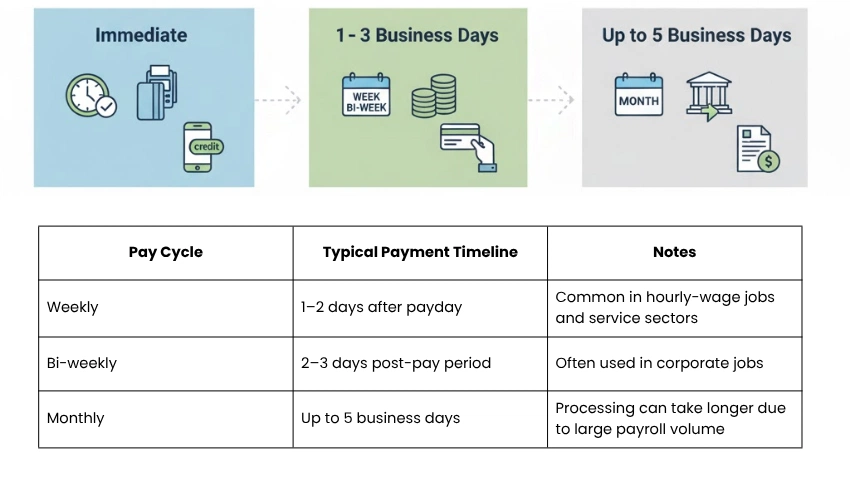
Here are common salary payment situations and how to understand them:
| Situation | What it means |
|---|---|
| Contract promises salary on the 1st, but it arrives on the 4th | It is later than the promised payday, even though it is before the statutory 7th-day deadline. Raise the delay with HR in writing. |
| Contract does not specify a payday, and salary arrives on the 9th | It is beyond the statutory deadline for monthly wages under Section 17(1). |
| The 7th falls on a Sunday, and salary is credited on Monday the 8th | The statutory deadline does not automatically move because the 7th falls on a Sunday. Employers should arrange payment in advance. |
| Only part of the monthly salary is credited | The unpaid balance may amount to underpayment of wages. The circumstances and amount due determine the applicable legal consequences. |
| Salary transfer fails because of incorrect bank details | The reason for the failed transfer matters. Confirm the error, correct the bank details and obtain a written date for reprocessing. |
Important: If your salary has not been credited by the statutory deadline, keep your payslips, employment agreement, bank statements and written communication with HR. These records can help establish the amount due and the date of payment if you need to raise a wage complaint.
4. What Is the Monthly Salary Due Date in India? Salary Calendar (November 2026 - December 2027)
Under Section 17(1) of the Code on Wages, 2019, monthly wages must be paid before the expiry of the 7th day of the following month. For example, October 2026 salary must be paid by 7 November 2026, while November 2026 salary must be paid by 7 December 2026.
The statutory deadline does not automatically move when the 7th falls on a Saturday, Sunday or bank holiday. Employers should therefore schedule payroll processing early enough to ensure employees receive their wages within the applicable deadline. The calendar below shows the due dates and recommended processing dates.
| Salary for | Statutory due date | Day | Recommended payment date |
|---|---|---|---|
| October 2026 | 7 November 2026 | Saturday | 6 November 2026 (Friday) |
| November 2026 | 7 December 2026 | Monday | 7 December 2026 (Monday) |
| December 2026 | 7 January 2027 | Thursday | 7 January 2027 (Thursday) |
| January 2027 | 7 February 2027 | Sunday | 5 February 2027 (Friday) |
| February 2027 | 7 March 2027 | Sunday | 5 March 2027 (Friday) |
| March 2027 | 7 April 2027 | Wednesday | 7 April 2027 (Wednesday) |
| April 2027 | 7 May 2027 | Friday | 7 May 2027 (Friday) |
| May 2027 | 7 June 2027 | Monday | 7 June 2027 (Monday) |
| June 2027 | 7 July 2027 | Wednesday | 7 July 2027 (Wednesday) |
| July 2027 | 7 August 2027 | Saturday | 6 August 2027 (Friday) |
| August 2027 | 7 September 2027 | Tuesday | 7 September 2027 (Tuesday) |
| September 2027 | 7 October 2027 | Thursday | 7 October 2027 (Thursday) |
| October 2027 | 7 November 2027 | Sunday | 5 November 2027 (Friday) |
| November 2027 | 7 December 2027 | Tuesday | 7 December 2027 (Tuesday) |
For HR and payroll teams: Treat the recommended dates as internal scheduling guidance, not alternative statutory deadlines. Allow time for payroll approval, bank file processing and failed transactions so that salary reaches employees within the applicable legal payment period.
5. Is Full and Final Settlement Due Within 2 Working Days in India?
Wages payable on resignation, removal, dismissal, retrenchment or closure must generally be paid within two working days under Section 17(2) of the Code on Wages, 2019. This requirement should not be confused with the deadline for every component of a Full and Final (F&F) settlement. Gratuity, statutory bonus and other exit-related payments may follow separate legal timelines.
Here is how the two-working-day requirement applies to common employee exit payments:
- Wages payable within two working days: Outstanding wages covered by Section 17(2) for the applicable exit event. This may include salary for days worked up to the relevant date.
- Gratuity: Generally payable within 30 days from the date it becomes payable under the Code on Social Security, 2020.
- Statutory bonus: Follows the separate payment timeline under the applicable bonus provisions of the Code on Wages, 2019.
- Resignation date and last working day: Do not automatically treat these as interchangeable. The applicable circumstances and interpretation of the statutory provision matter. Employees should obtain written confirmation from HR about the payment calculation and timeline.
- Pending exit clearance: Laptop returns, asset handovers and clearance procedures should not be used to justify withholding wages that are legally due. Any proposed deduction must comply with the applicable wage deduction provisions.
- Notice period recovery: If an employee has not completed the contractual notice period, any applicable notice-pay recovery should be clearly explained and itemised in the F&F statement.
- Relieving and experience letters: These are employment documents, separate from wage payments. Their issuance does not itself change the statutory wage payment deadline.
For employees: Request an itemised Full and Final Settlement statement showing unpaid salary, leave encashment, notice-pay adjustments, gratuity (if applicable), bonus and other recoveries. Check each payment against its applicable legal deadline rather than assuming that the entire settlement follows one common timeline.
6. How Is Full and Final Settlement Calculated? Worked Example
A Full and Final (F&F) settlement statement shows the salary payable up to the employee's exit date, eligible leave encashment, approved reimbursements, applicable deductions and other outstanding payments. The following example demonstrates how these amounts can be presented in an itemised settlement statement.
Illustrative example: Assume an employee earns a gross monthly salary of ₹60,000 and has a last working day of 20 November. The employee has 8 days of eligible leave, approved reimbursements of ₹2,500, a contractual notice shortfall of 5 days and a proposed tax deduction of ₹2,000.
| Settlement component | Calculation | Amount (₹) |
|---|---|---|
| Salary for 1–20 November | ₹60,000 × 20 ÷ 30 | 40,000 |
| Eligible leave encashment | 8 days × ₹1,000 | 8,000 |
| Approved reimbursements | Approved expense claims | 2,500 |
| Notice period shortfall recovery | 5 days × ₹2,000 | (10,000) |
| Illustrative tax deduction | Subject to applicable tax calculation | (2,000) |
| Illustrative net settlement amount | Total earnings less listed deductions | 38,500 |
How should the payment deadline be applied?
The table shows an illustrative overall settlement calculation, not a determination that the entire ₹38,500 must be paid within two working days. Section 17(2) of the Code on Wages, 2019 applies to wages payable on the specified exit events. Gratuity, statutory bonus and other settlement components must be assessed under their respective provisions.
For employees: Request an itemised F&F statement and check the salary calculation, leave balance, reimbursements, notice-pay recovery and tax deductions. Ask HR to explain any amount you do not recognise.
For employers and HR teams: Maintain separate payment timelines for wages and other exit benefits. Record the calculation, approval, deduction basis and actual payment date for every settlement component.
7. What Is the Fine for Late Salary Payment in India?
An employer may face a fine of up to ₹20,000 for contravening a wage payment provision, including the applicable payment deadline. If the employer pays an employee less than the amount legally due, the fine can extend to ₹50,000. These penalties are provided under Section 54 of the Code on Wages, 2019. The applicable provision depends on the nature of the violation.
Here is how Section 54 distinguishes the penalties:
- Late payment or another contravention: A contravention of a provision of the Code or its rules may attract a fine of up to ₹20,000 under Section 54(1)(c).
- Payment of less than the amount due: An employer who pays an employee less than the amount legally payable may face a fine of up to ₹50,000 under Section 54(1)(a).
- Repeat underpayment offence: If an employer convicted of underpayment commits a similar offence again within five years, the penalty may include imprisonment of up to three months, a fine of up to ₹1,00,000, or both under Section 54(1)(b).
- Repeat offence involving another contravention: A similar offence under Section 54(1)(c), repeated within five years after conviction, may attract imprisonment of up to one month, a fine of up to ₹40,000, or both under Section 54(1)(d).
- Opportunity to correct certain violations: Under Section 54(3), an Inspector-cum-Facilitator must generally issue a written direction and provide an opportunity to comply before prosecution for offences covered by Section 54(1)(c) or Section 54(2). This opportunity is not available when a violation of the same nature is repeated within five years.
Can an employee also claim the unpaid salary? Yes. An employee can approach the appropriate authority under Section 45 of the Code on Wages to claim unpaid or delayed wages. The authority may order payment of the amount due along with compensation, which can extend up to ten times the claim amount, subject to its determination. A wage claim is generally required to be filed within three years.
What should employees do if salary is delayed? First, send a written complaint to HR or the employer stating the wage period, expected payment date and actual payment status. Keep your payslips, employment agreement, bank statements and email or message records. If the issue remains unresolved, you can approach the appropriate labour authority with these documents.
8. What Changed Under India's New Labour Codes in 2025 and 2026?
India's four new Labour Codes came into effect on 21 November 2025, changing the legal framework for salary payments, employee benefits and workplace compliance. The Code on Wages, 2019 introduced a common wage-payment framework, including a monthly salary deadline, time-bound payment of wages on specified exit events and a longer period for filing wage claims. The Central Government subsequently notified the Code on Wages (Central) Rules, 2026 on 8 May 2026.
Here are the key developments employers and employees should understand:
- 21 November 2025 – Four Labour Codes came into force: The Code on Wages, 2019, Industrial Relations Code, 2020, Code on Social Security, 2020 and Occupational Safety, Health and Working Conditions Code, 2020 became effective. Together, they rationalised 29 existing central labour laws.
- Monthly salary payment deadline: Section 17 of the Code on Wages requires monthly wages to be paid before the expiry of the 7th day of the succeeding month. The payment provisions apply irrespective of the earlier wage ceiling under the Payment of Wages Act, 1936.
- 21 November 2025 – Time-bound exit wage payments: Section 17(2) introduced a two-working-day deadline for wages payable when an employee resigns, is removed, dismissed or retrenched, or when an establishment closes, subject to the provision's applicable conditions.
- Longer period for filing wage claims: Section 45 allows an employee to file a wage claim generally within three years from the date the claim arises. This is longer than the six-month period under the former Minimum Wages Act, 1948.
- 8 May 2026 – Central Wage Rules notified: The Government notified the Code on Wages (Central) Rules, 2026 through G.S.R. 343(E). These rules provide the detailed regulatory framework for establishments under the Central Government's jurisdiction.
- Central and State Government jurisdiction: The applicable rules depend on which government is the appropriate government for the establishment. Central Rules apply to establishments under Central Government jurisdiction, while State Rules apply where the State Government is the appropriate government. Employers should verify the relevant notifications and rules for their establishment.
Which older wage laws were replaced? The Code on Wages, 2019 consolidated and replaced four major central wage-related laws:
- Payment of Wages Act, 1936
- Minimum Wages Act, 1948
- Payment of Bonus Act, 1965
- Equal Remuneration Act, 1976
What should employers do before the 2027 payroll year? Review salary payment schedules, update payroll policies, align employee exit procedures with the applicable wage-payment deadlines, verify authorised deductions and check the relevant Central or State Rules. A payroll policy based on an outdated 10th-of-the-month deadline or a routine 30–45-day exit cycle should be reviewed against the current legal requirements.
9. What Is Included in Wages Under the Code on Wages? What Can an Employer Deduct?
What Is Included in the Definition of Wages?
Under Section 2(y) of the Code on Wages, 2019, wages include basic pay, dearness allowance and retaining allowance, where applicable. Certain payments, including house rent allowance (HRA), conveyance allowance, employer contributions to provident fund and other specified components, are excluded from the definition, subject to the conditions in the Code.
However, there is an important 50% rule. If the excluded components specified under the Code exceed 50% of the total remuneration, or another prescribed percentage where applicable, the excess amount is added back to wages for statutory purposes. This prevents employers from structuring an employee's remuneration with an excessively low wage component to reduce statutory benefits.
The definition matters when calculating statutory benefits and other wage-linked payments. However, the calculation method can differ depending on the applicable provision, so employees should not assume that every F&F component is calculated using the same wage figure.
What Salary Deductions Can an Employer Legally Make?
Section 18 of the Code on Wages, 2019 allows only authorised deductions from an employee's wages. An employer cannot make arbitrary deductions simply because they appear in an internal policy or payroll calculation.
- Permitted deductions: These include deductions for authorised fines, absence from duty, damage or loss, recovery of advances or loans, income tax, provident fund contributions and other deductions permitted under the Code.
- 50% deduction limit: The total deductions from an employee's wages in a wage period generally cannot exceed 50% of those wages. If authorised deductions exceed this limit, the excess may be recovered in the prescribed manner from subsequent wage periods.
- Fines and damage recovery: These deductions are subject to statutory conditions. Employees must be given an opportunity to explain before a fine is imposed, and deductions for damage or loss cannot exceed the actual loss attributable to the employee's neglect or default.
- Request an explanation: If your payslip shows an unfamiliar deduction, ask HR for the amount, reason and applicable legal provision or contractual basis.
What Are the Payment Deadlines for Overtime, Bonus and Gratuity?
Not every employee payment follows the monthly salary deadline. Different statutory benefits have separate eligibility requirements and payment timelines.
- Overtime wages: Overtime must be paid at the applicable rate, generally at least twice the normal rate of wages under Section 14 of the Code on Wages, 2019, and paid within the applicable wage-payment period.
- Statutory bonus: Eligible employees are covered by the bonus provisions of the Code on Wages. Bonus is generally payable within eight months from the close of the accounting year, subject to the applicable provisions and permitted extensions.
- Gratuity: Under the Code on Social Security, 2020, gratuity is generally payable within 30 days from the date it becomes payable. Fixed-term employees may qualify under a shorter service requirement than the general five-year rule, subject to the applicable provisions.
- Reimbursements and notice pay: These should be separately identified in the F&F statement. Their treatment depends on the nature of the payment, applicable policy, contractual terms and relevant legal provisions.
10. Who Pays If You Work Through a Contractor or Staffing Company?
If you are on the payroll of a staffing company or contractor, that employer must pay you within the same deadlines. If the contractor fails to pay, the Code generally makes the principal employer (the company where you are deployed) responsible for the unpaid dues, who can then recover them from the contractor.
- Keep your appointment letter, which should name your employer of record.
- Write to the contractor's HR first, then copy the principal employer's HR or the contract manager.
- Do not accept "the client has not paid us yet" as a reason. Your wage deadline does not depend on the client's payment cycle.
11. What to Do If Your Salary Is Not Credited
- 1. Confirm the date. Check your payday in the appointment letter and the 7th-day limit.
- 2. Rule out simple causes. Verify bank details, attendance and tax declarations in the HR portal.
- 3. Write to HR or payroll by email. Ask for the reason and the credit date.
- 4. Keep evidence. Save payslips, offer letter, bank statements and replies.
- 5. Escalate internally to your manager or the grievance channel after two working days without a reply.
- 6. Go to the authority. See the sections below on claims and where to file.

Email template: salary delayed
Subject: Salary for [month] not yet credited
Dear [HR name],
My salary for [month], due on [payday as per contract], has not been credited as of [today's date]. Please confirm the reason for the delay and the date by which it will be paid.
Under Section 17 of the Code on Wages, 2019, monthly wages are payable before the expiry of the 7th day of the following month. Kindly resolve this at the earliest.
Regards,
[Name, employee ID]
Email template: full and final settlement pending
Subject: Full and final settlement: employee ID [ID]
Dear [HR name],
My last working day was [date]. Section 17(2) of the Code on Wages, 2019 requires wages payable on exit to be paid within two working days. Please share an itemised settlement sheet and the date of credit. Gratuity, if applicable, may follow on its own statutory timeline.
Regards,
[Name, employee ID]
12. How Does a Wage Claim Work Under the Code on Wages?
If writing to HR does not work, Section 45 of the Code gives you a formal route.
- 1. Application: file a claim before the authority appointed by your state government, within three years of the claim arising.
- 2. Group claims: a single application can be made on behalf of several employees whose wages are unpaid.
- 3. Notice and hearing: the authority notifies the employer, who gets a chance to respond.
- 4. Order: if the claim is upheld, the authority can direct payment of the wages due along with compensation. Published summaries describe compensation of up to ten times the claim amount, but the authority decides based on the facts.
- 5. Appeal: either side can appeal under Section 49 to the appellate authority, commonly summarised as within 90 days.
Because procedures and forms vary by state, check your state labour department's website or office before filing.
13. Where to Complain About Unpaid Salary in India?
- Step 1: HR or payroll, then the reporting manager or grievance channel, all in writing.
- Step 2: the Inspector-cum-Facilitator or the labour department of your state government. Take your payslips, bank statements, appointment letter and email trail.
- Step 3: a formal claim before the authority appointed by the state, as described above.
- Provident fund or gratuity issues: these have separate routes through EPFO and the gratuity authority.
14. Why Does Salary Get Delayed?
- Missed cut-offs: late attendance or timesheet approval from a manager.
- Wrong bank details, so the transfer bounces back after a day or two.
- Statutory mismatches: PF, ESI, professional tax or TDS errors that hold a batch.
- Onboarding or exit gaps, such as missing documents or an incomplete master record.
- Manual spreadsheet payroll, with more touchpoints and more errors.
- Bank cut-offs and holidays: files sent late settle the next working day.
- Cash-flow stress: if the whole team is paid late repeatedly, treat it as a business-health signal.
How employees can avoid avoidable delays: submit attendance and tax declarations before the cut-off, tell HR in writing when your bank account changes, and check your payslip every month for anything unexpected.

15. What Are the UAE Salary Rules in 2026?
Many candidates placed by Voltech HR Services work in the Gulf, so this section matters. From 1 June 2026, MOHRE Ministerial Resolution No. 340 of 2026 replaced the 2022 wage protection rules for private-sector establishments registered with MOHRE.
- Unified due date: salary for a month is due on the 1st of the following month, paid through the Wage Protection System (WPS) or another MOHRE-approved system.
- Automated monitoring: media reports describe warnings from about the second day of delay, permit suspension from about the fifth day, and harsher action including prosecution referrals from about the 21st day.
- Grace period: the old 15-day grace was removed. Some law-firm summaries still describe a 10-day window before administrative penalties, so published sources differ.
- New joiners are no longer exempt for their first 30 days, according to law-firm summaries.
- Your right to claim any unpaid balance is unaffected.
- Free zones such as DIFC and ADGM have their own employment rules.
- End of service: Federal Decree-Law No. 33 of 2021 generally expects dues within 14 days of the contract ending.
If your UAE salary is late: keep payslips and bank statements, then contact MOHRE through the 80060 line, the MOHRE app or mohre.gov.ae. Because enforcement details have been moving, treat the current MOHRE page as the final word.
16. UK and USA Salary Rules in Brief
United Kingdom: no statutory payday applies, so your contract governs, and section 13 of the Employment Rights Act 1996 makes unauthorised deductions unlawful. For acts on or after 1 October 2026, the tribunal time limit is six months less one day, up from three months less one day. Acas early conciliation comes first. Earlier acts keep the three-month limit.
United States: the Fair Labor Standards Act requires earned wages on the regular payday but sets no federal final-paycheck deadline. State law fills the gap. Some states require immediate final pay and others the next regular payday, so check your state labor department.
17. Country Comparison Table
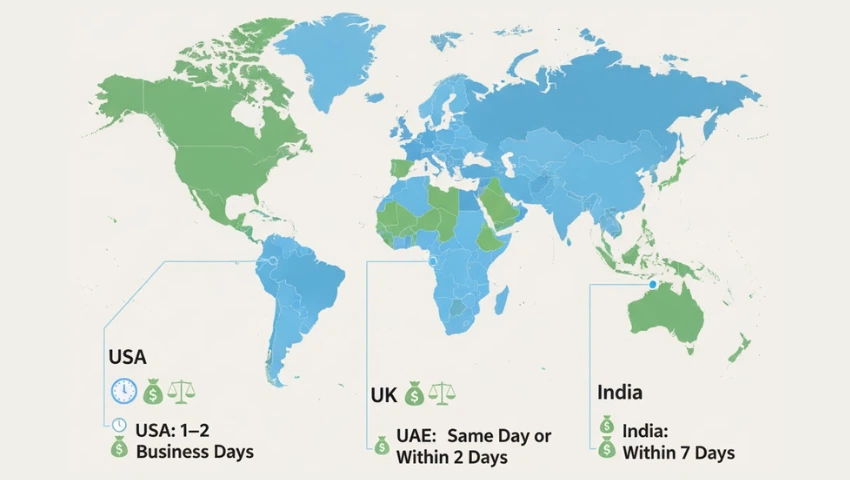
| Country | Monthly pay rule | Exit dues | Where to complain |
|---|---|---|---|
| India | Before the end of the 7th of the next month (Code on Wages, s.17) | Two working days | State labour department or Inspector-cum-Facilitator |
| UAE (mainland) | Due on the 1st of the next month via WPS (from 1 June 2026) | Generally within 14 days | MOHRE |
| UK | As per contract; no fixed statutory day | As per contract | Acas, then employment tribunal (six months less one day from 1 Oct 2026) |
| USA | Regular payday; state law applies | Varies by state | State labor agency or US Department of Labor |
18. Employer Checklist and Payroll Calendar for 2027
Late salary damages trust, invites penalties and raises attrition. Working backwards from the 7th gives HR a calendar that survives weekends and holidays. This is a sample for an employer that pays by the 5th:
| Step | Suggested date (for the previous month's salary) |
|---|---|
| Attendance and leave cut-off | 25th of the salary month |
| Manager approvals closed | 27th |
| Input freeze (joiners, exits, arrears, deductions) | 28th |
| Payroll run and variance check | 30th or last working day |
| Finance approval and bank file | 1st to 2nd of the next month |
| Salary credit target | By the 5th |
| Statutory buffer | 6th to 7th (use only for emergencies) |
- Pay on the contractual date even when it is earlier than the 7th.
- Move F&F workflows to a two-working-day clock and issue an itemised statement.
- Check that wages (basic plus DA) meet the 50% definition in your salary structures.
- Validate bank details with a test transfer at onboarding and after any change.
- Keep wage slips and records ready for inspection, and track PF, ESI, TDS and professional tax on a separate calendar.
- Make sure contractors and staffing vendors pay on time, since the principal employer can be responsible for unpaid dues.
- For Gulf operations, align the calendar to the UAE 1st-of-the-month rule.
Employers who prefer to outsource this can use our Staffing & Payroll Services, which cover payroll processing, statutory compliance and payslip management.
19. Common Myths
- "Salary can wait until the 10th." That was the older rule. The Code on Wages sets the 7th.
- "Only low earners are protected." The payment provisions apply irrespective of salary.
- "F&F takes 45 days." The wages part is due in two working days. Gratuity has its own 30-day clock.
- "A holiday moves the deadline." Banks shift, the statutory limit does not.
- "The employer can deduct anything for notice or damages." Only authorised deductions are allowed, and the total is capped at 50% of wages in a wage period.
- "Complaining will get me fired." Retaliation can itself be challenged, so keep everything in writing.
20. FAQ
What is the last date for salary payment in India?
For monthly-paid employees, salary must be paid before the expiry of the 7th day of the following month under Section 17 of the Code on Wages, 2019. If your contract promises an earlier date, that earlier date applies.
Within how many days must full and final settlement be paid in India?
Wages payable on resignation, removal, dismissal, retrenchment or closure must be paid within two working days under Section 17(2). Gratuity follows a separate 30-day process under the Code on Social Security.
What is the penalty for late salary in India?
Under Section 54, paying an employee less than what is due can attract a fine of up to Rs 50,000 for a first offence. A repeat offence within five years can lead to up to three months' imprisonment, a fine of up to Rs 1,00,000, or both. Other contraventions of the Code may attract a lower general penalty.
Is salary late if it is credited after the 7th?
Yes. For monthly wages the 7th is the statutory outer limit, so a credit after the 7th is a compliance failure unless a different limit applies under your state's rules or another law.
Where do I complain if my salary is not paid in India?
Write to HR first, then escalate to your reporting manager or grievance channel. If unresolved, approach your state labour department or the Inspector-cum-Facilitator, or file a claim before the authority appointed under Section 45 of the Code on Wages.
How long do I have to claim unpaid wages in India?
The Code on Wages sets a limitation period of three years for worker claims, but raising the issue in writing quickly gives a stronger record.
Can an employer deduct more than 50% of my salary?
Under Section 18 of the Code on Wages, only authorised deductions are allowed, and total deductions in a wage period cannot exceed 50% of wages. Any excess is carried forward and recovered from later wage periods.
Can my employer withhold salary during my notice period or until exit clearance?
Only in line with your contract and the Code's deduction rules. Withholding earned wages without a lawful basis can be challenged.
Is there compensation for delayed wages in India?
A claim before the authority under Section 45 can lead to an order to pay the wages due along with compensation. Published summaries describe compensation of up to ten times the claim amount, but the authority decides based on the facts of each case.
When must gratuity be paid after leaving a job?
Gratuity is paid within 30 days of becoming payable under the Code on Social Security, 2020. It is separate from the two-working-day deadline for wages on exit.
When is salary late in the UAE in 2026?
From 1 June 2026, salary is due on the 1st of the following month under MOHRE Resolution No. 340 of 2026. Published summaries differ on any grace days before penalties, so confirm with MOHRE.
What is the time limit for an unpaid wages claim in the UK?
Six months less one day for acts on or after 1 October 2026, after Acas early conciliation. Earlier acts keep the three-month limit.
Sources
- India Code: The Code on Wages, 2019
- PRS India: Code on Wages (Central) Rules, 2026
- PRS India: Code on Wages, 2019 (full text)
- Business Standard: Centre notifies final IR and Wage Code rules
- LiveLaw: Two working days, Code on Wages and final settlement
- LawSikho: Full and final settlement in India, 2-working-day rule
- Mondaq: The New Indian Code on Wages, 2019 (penalties, wage definition, claims)
- Gulf News: UAE salary deadline from June 1
- The National: What to do if your UAE salary is late
- Mondaq: New UAE WPS salary rules for employers
- DLA Piper: Employment Rights Act changes from October 2026
- Acas: Deductions from pay and wages
Need payroll that always lands on time? Voltech HR Services manages payroll and statutory compliance for employers across India. Talk to our team.
Subscribe for latest update

Write Comment