
-
 Call: +91-9840269190
-
 Mail: hr@voltechgroup.com

Skipping ₹800 BGV can cost ₹5L in bad hires in 2026
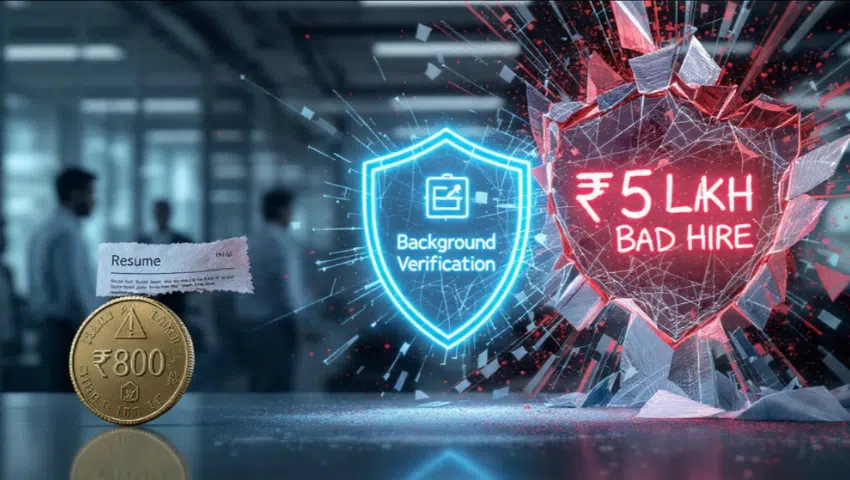
Skipping an ₹800 Background Check Costs Indian Companies an Average of ₹5 Lakhs in Bad Hires in 2026.
- By Jagannathan M
- December 19, 2025
⚡ TL;DR:Background verification (BGV) is evolving from a compliance headache to a vital defense against surging fraud-especially in AI-forged resumes and dual employment - in the Indian remote market for jobs.
Key Mandates for 2026:
1. Tech: API-first platforms that use AI/ML to instantaneously conduct digital checks (UAN, Aadhaar, etc.) to achieve TATs well below 24 hours and accuracy of 99.5%.
2. Compliance: The DPDP Act is non-negotiable. Vendors must provide unbundled consent and explicit consent and integrate rigorous data security and privacy, to eliminate extreme regulatory risk.
3. Financial and reputational risk from bad hires requiring 6-12 months of recovery time, costing Up to 30% of yearly salary, prompts the search for human trust and source-based thoroughness that blend with digital’s speed across hiring geographies.
.webp "Skipping ₹800 BGV can cost ₹5L in bad hires in 2026")
The top priority for companies hiring in India remotely will be to ensure that applicants are legitimate rather than to find talent. Taking chances based on resumes when the market is moving quickly is not only risky but costly as well.
Searching for "what are the best background verification companies in India 2026" means you are looking to make a strategic decision. You need a partner that can provide you with background verifications quickly, compliant with the law and very reliable. Forget the pretty brochures; let us look at what the data indicates you should expect to see in 2026.
📈 Why BGV is Changing - 2026 Reality Check
.webp "Skipping ₹800 BGV can cost ₹5L in bad hires in 2026")
The world of work has changed drastically with remote hiring becoming standard. In addition, the Digital Personal Data Protection (DPDP) Act has changed the landscape in a significant way. In addition, scammers have become adept at producing sophisticated fraudulent documents \ through the use of AI. The question is no longer if you need verification, but what happens if you skip background verification in 2025.
Data Point Summary:
• The discrepancy rate: The overall discrepancy rate for background checks in India is between 10% and 12%. In some industries, particularly in BFSI, it can be as high as 18.1% per year (primarily from employment and education checks).
• The Rise of Identity-Fraud in Remote Hiring: The growth associated with remote work has made it much simpler to misrepresent multiple jobs (dual employment) or to give a false address. In 2024, we will observe an approximate 25% increase in attempts at identity fraud in the gig economy and remote hiring sectors due to AI-generated resumes. This trend is driven by the rise of AI-forged resumes, which is why smart verification matters.
• The Compliance Cost: One-time generic consent forms do not meet current compliance standards. The financial liability of being out of compliance with the DPDPA's new compliance standards is considerably greater than the total cost of your BGV program for that year. Your vendor needs to act as your BGV compliance shield.
🛡️ Choosing Your BGV Co-Pilot: Three Trust-Building Pillars
How do you sort the top-tier players from the rest? Stop looking at price alone. Focus on these three non-negotiables:
1. ⚙️ Platform (Technology & Speed)
In 2026, your BGV provider will be a technology company first. The technology platform will drive your TTH. This technological advancement is key to understanding what the future of BGV for HR is in 2026.
• INSIGHTS: A vendor using an advanced technology platform to provide digital checks will take 90% less time than a vendor using manual checks on Aadhaar e-KYC and UAN verification.
• Trust Factor: Does the technology platform have a first-class API? Integration directly into your ATS will reduce the number of human errors made while entering data from 65%, which are the leading cause of false negatives in the BGV process. Additionally, the technology platform should utilize AI and ML to assist in detecting sophisticated digital forgeries and improve the document accuracy rate by an average of 99.5%.
2. Compliance: The DPDP Act Shield
The DPDP (Digital Personal Data Protection) Act requires that individuals give explicit, informed and revocable consent. Your Background Verification Provider (BGV) partner must integrate this requirement into their operations.
DPDP Compliance Takeaways:
• Explicit Consent - A BGV provider should have an automated process for capturing explicit, auditable and unbundled consent from each candidate (e.g., capturing consent for a criminal background check separately from education credentials).
• Data Minimisation - Leading providers collect only the data that is required for the specific role being recruited (95% of our Background Verification checks are based on the role to ensure compliance and reduced invasiveness).
3. Coverage & Reach: Remote Hiring is the New Normal
You may be hiring remote employees in Mumbai, Bangalore and Tier-2 cities; will the BGV vendor you choose be able to deliver fast and accurately across all those areas?
• Market Insight - The BGV market is made up of several large players (e.g., Voltech HR Services, OnGrid, First Advantage, IDfy, AuthBridge, HireRight, Quinfy, Verifacts), each of whom focuses on different areas:
• Compliance-First & Multi-Sector Expertise – Voltech HR Services is recognized for its source-based, multi-layer background verification approach, combining human expertise with digital validation. It is well-suited for BFSI, IT, healthcare, manufacturing and overseas/GCC hiring, where accuracy, regulatory compliance and trust are critical.
• Startup / Tech Focus – IDfy and OnGrid are widely adopted for their rapid, API-driven verification solutions and are well received by digital-first startups, fintechs and platform-based businesses.
• On-Ground Reach – Companies such as Verifacts have established strong reputations for conducting in-person address and physical verification checks, which are essential for logistics, manufacturing and gig economy roles.
📊 Quick Comparison: Top BGV Providers in India 2026
| Feature | Provider A (Tech-Focused) | Provider B (Global/Enterprise) | Provider C (Hybrid/Tier-2 Reach) | Your BGV Service Advantage |
|---|---|---|---|---|
| Core Strength | Fastest TAT, API Integrations | Global Compliance, Enterprise Scale | Deep On-Ground/Physical Checks | Hybrid (Speed + Coverage + Compliance) |
| Digital Check TAT | 24-48 Hours (e-KYC, UAN) | 48-72 Hours | 48-72 Hours | 24 Hours for Instant Checks |
| Compliance Certs | ISO 27001, DPDP Aligned Workflow | ISO 27001, PBSA, Global Compliant | ISO 9001, NASSCOM Member | SOC 2 Type II, ISO 27701 (Privacy), DPDP |
| Discrepancy Capture Rate | High (AI-driven document analysis) | High (Multi-layer QA) | Good (Human-validated field checks) | 99.5% Accuracy Rate on Digital Checks |
| Best For | Startups, High-Volume Digital Hiring | MNCs, Regulated Industries (BFSI) | Logistics, Blue/Grey Collar Staffing | Evolving Mid-Market & Digital Enterprises |
Trust-Building Factor: A 99.5% accuracy rate isn't a boast; it’s a commitment. We achieve this by cross-referencing instant API data with human-verified field checks, ensuring you never miss a red flag.
💡 Case Study: How We Mitigated a Remote Hiring Disaster
A FinTech company based out of Bengaluru and hiring remote software developers/engineers was using a low-cost provider to conduct background checks (BGVs); their typical turnaround time was 12-15 days. An experienced developer had been marked "verified" by just receiving an email.
While verifying the same candidate for the FinTech client of Voltech HR Services
We found that:
1. 70% of the content on the experience letter was fabricated
2. There was an active dual employment status as verified through the UAN-EPFO file
3. Our manual verification had identified discrepancies in payroll data, whereas the typical Vendor’s manual verification process would not have detected these discrepancies.
Results:
• 80% reduction in BGV time (from 15 days to 3 days).
• High-risk hire avoidance, thereby mitigating risk to sensitive employee data and maintaining compliance.
Voltech HR Services were able to provide confidence in faster hiring, more compliant hiring processes and increased reliability.
🛡️ How to Choose a Reliable BGV Provider in India for 2026: The 3 P-Factors
You should not evaluate your BGV provider merely based upon "cost." A typical bad hire will cost you as much as 30% of their annual salary, so to put this in perspective for you, the cost of proper background screening is significantly lower than the cost associated with making a bad hire. Your primary considerations when selecting a vendor should be:
1. ⚙️ Platform (Technology & Speed)
In the year 2026, your vendor for BGVs will be considered 'a technology company' and the platform your vendor uses will determine your overall TTH.
• INSIGHTS: You should look for providers who provide an API-first product offering, meaning that they're able to plug into the HR software you use to manage your employees (e.g. ATS or HRMS). By using this type of solution, it will eliminate the need to manually enter your employee's information, reducing the risk for human error by up to 65%.
Takeaways (Speed & Accuracy):
o Fast/Instant Checks: The verification of digital information (e.g. Aadhaar e-KYC, PAN, UAN integration) should occur with a TAT of 24 hours.
o AI fraud detection: The vendor must use AI and ML to identify complex and sophisticated digital forgery to increase the accuracy of documents by an average of 99.5%.
2. 📜 Privacy (DPDP Compliance Shield)
You must comply with India's Data Protection Programme, known as DPDP, which is a requirement as of 2026. The DPDP requires companies to follow strict guidelines when collecting and storing personal information. If your provider does not comply with the DPDP, you, as the data fiduciary, will be responsible for any fines that reach a maximum of ₹250 crores (2.5 billion rupees) for significant breaches of the DPDP.
• Insight: The vendor you choose must provide you with explicit, precise and independent consent from each candidate for each inquiry. The days of generic consent forms are long gone.
Takeaways:
o Certifications: Make sure that your provider can show you evidence of ISO 27001 (Security) and ISO 27701 (Privacy), which indicates that their infrastructure meets global standards for protecting data.
o Data Minimization: Your provider should only collect the information required to verify the candidate, in accordance with the principle of Purpose Limitation as set forth in the DPDP.
3. 🌐 Presence (Coverage & Scope)
As remote hiring becomes more common, the number of locations from which candidates come will increase. Vendors will have the ability to verify the quality of candidates in different regions (e.g., Tier-1, Tier-2, etc.). Will they still deliver quality verification in all regions?
• Insight: The most reputable companies combine rapid digital searching with high-quality verification of addresses and references in the field, which is particularly important for displacing logistics or field-based candidates.
• Trust: Ask for the provider's discrepancy rates. A reputable background verification partner should have a formal and documented process for how to handle discrepancies and should be able to confirm or deny claims based on verified audit trails.
🏆 Top Background Verification Services & Tools in India for 2026
.webp "Skipping ₹800 BGV can cost ₹5L in bad hires in 2026")
Choosing a vendor depends heavily on your hiring volume and industry. Here’s a snapshot of the top-rated players and their strengths:
| BGV Provider | Core Strength & Focus | Best For (Industry) | Key Tech / Service (2026) |
|---|---|---|---|
| Voltech HR Services | Compliance-First, Multi-Layer Verification Expertise. | BFSI, IT, Healthcare, Manufacturing, GCC & Overseas Hiring | Source-Based Verification, Human + Digital Validation, DPDP-Compliant Workflows |
| First Advantage / HireRight | Global Standard, Enterprise Scale. | MNCs, BFSI (High-Compliance) | International Checks, Standardized QA |
| IDfy / OnGrid | Digital-First, High Automation | FinTech, Startups, Gig Economy | Fastest Digital TAT, API Integration, Document AI |
| AuthBridge | Established Player, Comprehensive Risk | Large Indian Corporates, Telecom | AI-Powered Checks, Due Diligence, Vendor Screening |
| SpringVerify / HelloVerify | SME & Startup Focus, Cost-Effective | Small to Mid-Sized Businesses | Simple Dashboard, Quick Online Reports, Easy Onboarding |
Where can I order quick background verification reports online in India?
Companies such as Voltech HR Services, OnGrid, IDfy and SpringVerify offer fast, online-first reports using APIs and digital integrations (UAN, DigiLocker, Aadhaar-linked checks). The use of APIs and digital integrations make it possible for these companies to deliver instant reporting (or up to 48 hours) to the client’s portal on an applicant's identity and digital employment history.
🎯 Deep Dive: Verifying Employment History in 2026 (The Crucial Check)
Employment History Verification (EH) continues to be an area that is heavily abused. The breakdown and inflation of roles tenures and the filling of job gaps is abundant in Industry data and results in discrepancies that occur in more than one out of every 10 checks.
The Modern, Data-Driven Employment Check
| Old Way (Slow & Risky) | New Way (Fast & Accurate) | Efficiency Gain |
|---|---|---|
| Contacting HR/Landlines (Low Response Rate) | API Integration with UAN/EPFO Databases | 90% Faster verification of employment existence and tenure. |
| Accepting PDF letters (Easy to forge) | AI Document Tamper Detection & Digital Signatures | 99.5% Accuracy in spotting fake documentation. |
| General reference check (Subjective feedback) | Role-Specific Digital Reference Forms | Structured feedback, 55% higher completion rate from managers. |
Case Insight: We came across a case recently where through cross-referencing a candidate's salary slip manually with their UAN (Universal Account Number) PF contribution data, we were able to identify a claim of ₹5 lakh salary inflation that would have been missed by a manual check. When data is involved, it beats paper every time.
🔐 The Final Word on Data Privacy (The DPDP Act in Action)
The question is not whether background verification services are set up to handle compliance, rather it is about how well background verification services have implemented the DPDP Act.
1. Capture Verifiable Consent: Background verification service companies should have a digital, auditable trail to provide evidence of an applicant giving consent for the specific check that is being conducted on their behalf.
2. Ensure Data Security: All data in both transit and while at rest should be encrypted (SOC 2 Type II and ISO 27001 are both solid proof points for this).
3. Implement Data Disposal Protocols: Once the specified purpose has been completed, they need to delete the personal data as retaining personal data without consent to retain would be illegal.
Trust Building Factor: Only partners that consider compliance as their primary product should be accepted as opportunities for partnership. The penalties surrounding non-compliance can be catastrophic, resulting in bankruptcy for small businesses.
Author Bio & Capability:
Author: [Jagannathan, BGV General Manager at Voltech HR Services]
I’ve been working in the background verification (BGV) and vendor screening space for over 5 years, closely handling employment checks, identity verification and compliance reviews for Indian companies. I’ve worked directly with vendor-based BGV processes, which means I’ve seen where resumes go wrong, where verification fails and how smart checks prevent costly hiring mistakes.
This blog is written from real, hands-on experience - Dealing with dual employment cases, forged documents and compliance gaps - not from theory. My goal is simple: help businesses hire faster, safer and with confidence in 2026.
FAQ's:
1. Is online background verification legally valid in India?
Yes - if:
Explicit, Informed and Revocable Consent is captured. Source-Based Data Used for Verification (UAN, DigiLocker, Aadhaar Api). Provider complies with DPDP Act. Employers Attract Legal Liability for non-compliant on-line checks.
2. Why is employment history verification the most critical check?
• Commonly falsified items
• Inflated Job Titles or Employment Tenures
• Fake Experience Letters
• Hidden Dual Employment
Modern BGV employs UAN-EPFO APIs combined with payroll cross-verification to achieve ~99.5% accuracy - Far higher than by email or HR calls.
3. What is dual employment and why is it risky?
Dual employment occurs when a candidate works for two employers simultaneously, often undisclosed.
Risks include:
• Data leaks
• IP theft
• Compliance violations
• Productivity loss
It is increasingly detected only through UAN-based employment checks.
4. What happens if I skip background verification?
Skips BGV have consequences such as:
• Hiring Fraudulent/Non-Existing Profiles
• Requires employers to be compliant with DPDP Regulations
• Costs per bad hire may amount to 30% of annual salary.
• Reputation/Legal Exposure
In 2026, the BGV verification process needs to be followed to prevent greater risk.
Subscribe for latest update

Write Comment