
-
 Call: +91-9840269190
-
 Mail: hr@voltechgroup.com

What to Do When a Background Verification Report Says "Unable to Verify" (UTV): The 2027 HR Action Guide

What to Do When a Background Verification Report Says "Unable to Verify" (UTV): The 2027 HR Action Guide
- Published:
- Last updated:
- By Jagan.M, Voltech HR Services
- UTV is a neutral status, not a fraud finding. “Unable to Verify” (UTV) is an Amber status meaning the ex-employer, university or other verifier did not respond within the turnaround time (TAT).
- Employment history is the most frequent discrepancy area. AuthBridge's Workforce Fraud Files for the first half of fiscal year 2025-26 (H1 FY26) report an 11.15% employment discrepancy rate for white-collar hires, ahead of address (7.68%) and education (4.49%). These are confirmed discrepancies, not UTV rates.
- Secondary government-linked proofs can close many UTV cases. EPFO UAN service history, Form 16, Form 26AS or AIS, MCA21 company status and NAD or DigiLocker records let HR confirm facts without waiting for an unresponsive HR desk.
- A UTV rate above 5% points to a vendor process gap. Voltech HR Services treats a sustained final UTV rate above 5% as a reason to audit the vendor's follow-up log and employer contact database.
- Never waive the check. Use a signed conditional offer clause, restricted system access and a fixed closure window when a joining date arrives before the check closes.
- Use a fixed timeline. Confirm vendor attempts by day two, start secondary checks by day three and decide on closure or escalation by day seven.
A background verification (BGV) report that shows “Unable to Verify” (UTV) means the screening agency could not confirm one of the candidate's details, such as past employment, a degree or an address, with the primary source. UTV is not a failed check. It is an open case that HR must close with a documented secondary proof route.
This guide gives HR teams in India a practical method for handling UTV: how to read the status, why it happens, which government-linked proofs can replace a silent verifier, how to protect a joining date and how to tell when the real problem is the vendor.
In this guide: what UTV means, how it differs from insufficiency and discrepancy, the five most common causes in India, a four-step HR procedure with a seven-day timeline, a secondary proof matrix, how to handle joining dates, why high UTV rates are often a vendor problem, UTV by check type, data protection basics, a self-assessment, how Voltech HR Services closes UTV cases and answers to ten common questions.
What Does “Unable to Verify” (UTV) Mean in a Background Verification Report?
The table below defines the four statuses HR teams see most often in BGV reports and the action each one calls for. UTV sits between a clean result and a confirmed discrepancy.
| BGV Report Status | Color Code | Operational Definition | Recommended HR Action |
|---|---|---|---|
| Clear / Verified | Green | Submitted candidate details match official primary or secondary records. | Proceed with unconditional onboarding. |
| Insufficiency | Yellow / Blue | Mandatory inputs are missing, such as a blurred relieving letter, missing employee ID or unsigned authorisation letter. | Pause the TAT clock and request the missing document from the candidate within 48 hours. |
| Unable to Verify (UTV) | Amber / Orange | Complete documents were submitted, but the verifier (employer HR or university) is unreachable, closed or non-cooperative. | Trigger secondary digital verification (EPFO, Form 26AS, MCA check). |
| Discrepancy (Major) | Red | The verifier officially confirms falsified tenure, a fake relieving letter, a forged payslip or a terminated status. | Issue a show-cause notice and follow the offer revocation process in your compliance policy. |
How to Tell Insufficiency, UTV and Discrepancy Apart
Ask three questions in order. The first “yes” tells you which status applies:
- Did the candidate submit every mandatory document and detail? If no, the status is Insufficiency and the next step sits with the candidate.
- Did the verifier respond with a confirmation or denial? If no response was received, the status is UTV and the next step sits with the vendor and HR.
- Did the verifier confirm details that differ from the candidate's claim? If yes, the status is Discrepancy and the next step is a documented HR decision.
The practical difference is the cause. Insufficiency is a candidate-side gap, UTV is a verifier-side gap, and Discrepancy is a confirmed mismatch. Only the last one is a fraud indicator.
Why Do Background Checks Come Back as “Unable to Verify” in India? (Top 5 Causes)
The table below summarises verified benchmarks from AuthBridge, UGC, HireRight and IDfy. It shows where checks fail most often in India and why each figure matters when HR reads a UTV status. Most of these figures measure confirmed discrepancies or fraud, so use them as risk context rather than as UTV rates.
| Benchmark | Reported Figure | Source | Why It Matters for HR |
|---|---|---|---|
| Employment history discrepancy rate, white-collar hires | 11.15%, the highest of any check type for white-collar hires | AuthBridge Workforce Fraud Files, H1 FY26, which AuthBridge says draws on 15 million monthly checks (The Tribune / ANI, 17 February 2026) | Employment is where open and disputed cases concentrate, so it deserves the most escalation effort. |
| Address discrepancy rate | 7.68% for white-collar hires; 9.70% for on-demand (gig) workers | AuthBridge Workforce Fraud Files, H1 FY26 (The Tribune / ANI) | Address checks depend on field visits, so locked premises and relocations raise the chance of a stalled case. |
| Education discrepancy rate | 4.49% for white-collar hires | AuthBridge Workforce Fraud Files, H1 FY26 (The Tribune / ANI) | Education checks run lower than employment checks, but offline universities and fake institutions still cause stalls. |
| Overall discrepancy rate | 4.33% for white-collar hires; about 5.6% for gig workers | AuthBridge Workforce Fraud Files, H1 FY26 (The Hans India) | Gives HR a baseline to compare a vendor's overall results against. |
| Institutions on the UGC fake university list | 32 institutions as of February 2026, with Delhi holding 12 | University Grants Commission (UGC) list, as reported by Careers360 | A degree from a listed institution cannot be verified as valid. Always compare against the current UGC list. |
| Indian organisations that found identity fraud | 74% discovered identity fraud in 2025, the highest of any market surveyed | HireRight and YouGov survey (HireRight) | Shows why a UTV status should be closed with independent evidence and not waived. |
| Losses from employee-led collusion fraud | More than Rs 150 crore in 2025, based on 4.9 million cases processed | IDfy Report on Workforce Risks and Hiring Fraud 2025 (CXO Digital Pulse) | Shell employers and forged employment records make entity checks necessary. |
These figures measure confirmed discrepancies, institution status and fraud losses. None of them is a UTV rate. A UTV status means the verifier did not respond, so compare your own UTV rate with your vendor's history and with the 5% review threshold used in this guide.
1. Unresponsive or Overloaded Ex-Employer HR Teams
Ex-employer HR desks are the most common reason for UTV. Verification requests wait in shared inboxes during the verification turnaround window, and manual email follow-ups get ignored during appraisal and peak hiring seasons. See our guide on how to verify employment when previous employers never respond.
What HR can do:
- Ask the candidate for a named reporting manager or HR contact who can confirm tenure.
- Request the vendor's log of emails, calls and escalation contacts before accepting UTV.
- Run EPFO UAN and Form 26AS checks in parallel instead of waiting for a reply.
2. Previous Company Shut Down, Acquired or Unregistered MSME
A company that has been struck off from the Ministry of Corporate Affairs (MCA) register, merged into another group or never registered as an MSME has no active HR desk to answer. Startups are the usual example. See how to verify employment when a company has shut down.
What HR can do:
- Check the company's CIN, incorporation date and Active or Strike-Off status on MCA21.
- Look for the acquiring or successor entity and request verification from its HR team.
- Match tenure using EPFO UAN history, Form 16 and salary credit statements.
3. Third-Party Staffing and Contract-to-Hire Payroll Mismatches
A candidate may list a client brand, such as a large IT enterprise, while the legal employer and PF account belonged to a staffing agency. The enterprise HR team then replies “No Record Found”, which the vendor logs as UTV. See verifying candidates hired through a third-party staffing agency.
What HR can do:
- Ask the candidate for the offer letter and payslips to identify the legal employer.
- Direct the verification request to the staffing agency, not the client brand.
- Confirm the PF establishment name on the EPFO UAN passbook.
4. Offline State Universities and UGC-Flagged Institutions
Some state universities still need physical demand drafts or postal requests, and institutions on the UGC list of fake universities cannot be confirmed at all. Both cause education checks to stall. See what to do when a university does not respond.
What HR can do:
- Fetch the degree through NAD or DigiLocker where the institution is onboarded.
- Compare the institution name against the current UGC list of fake universities.
- Escalate to a postal or in-person verification only when digital routes fail.
5. Locked Premises or Frequent Relocation in Address Checks
Field verifiers in Tier-1 and Tier-2 cities often find locked doors or uncooperative PG and society guards, so the address cannot be confirmed in person. See physical address verification.
What HR can do:
- Offer the candidate a scheduled visit window instead of an unannounced visit.
- Use a geo-tagged digital address check with a utility bill or rental agreement.
- Verify a second address, such as a permanent address, if the current one is a shared stay.
4-Step HR Standard Operating Procedure (SOP) to Resolve UTV Cases
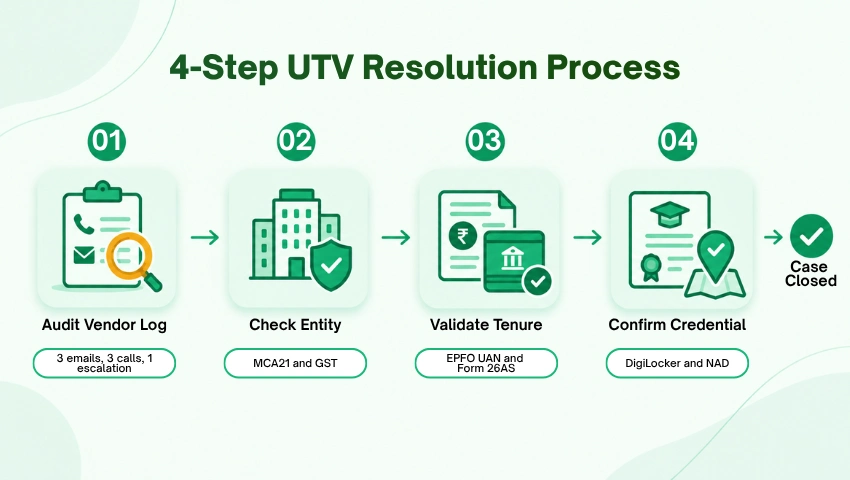
The table maps each step to the failure it addresses, the current fallback check, the proof source and the risk it reduces.
| SOP Step | Primary Verification Failure | Secondary Digital Fallback (Current Standard) | Proof Source | Fraud Risk Mitigated |
|---|---|---|---|---|
| Step 1: Audit vendor log | HR email unanswered | At least 3 emails, 3 phone calls and an alternate escalation contact over 5 to 7 business days. | Vendor SLA audit trail | Prevents premature ticket closure. |
| Step 2: Entity check | Company unreachable or shut down | Cross-check CIN, incorporation date, Active or Strike-Off status and filing compliance. | MCA21 portal and GST search portal | Detects shell companies and fake-experience mills. |
| Step 3: Tenure and payroll | Ex-HR does not reply | Match date of joining, date of exit, employer PF remittances and TDS deductions. | EPFO UAN passbook, TRACES Form 16, Form 26AS or AIS | Proves salaried tenure without depending on ex-HR. |
| Step 4: Credential or address | University or landlord is silent | Fetch the digital degree certificate; run a geo-tagged digital address and utility check. | DigiLocker, NAD, geo-fenced KYC link | Removes postal delays and missed field visits. |
Step 1: Audit the Vendor's Contact Log
Request the vendor's attempt log for the case. A defensible UTV closure shows dated contact attempts across more than one channel and an escalation to an alternate contact. If the log shows only automated emails, ask the vendor to reopen the case before HR spends effort on secondary checks.
- Minimum standard: 3 emails, 3 phone calls and 1 alternate escalation contact over 5 to 7 business days.
- Check that the contact used is a named HR or payroll person, not a generic info@ mailbox.
- Record the date the log was received and who reviewed it.
Step 2: Run the Entity Check
Confirm that the previous employer exists and was operating during the candidate's claimed tenure. Search the company on the MCA21 portal for its Corporate Identification Number (CIN), incorporation date and current status, then search its GSTIN on the GST search portal.
- A company that was Active during the claimed tenure supports the claim.
- A company struck off after the claimed exit date is consistent with a genuine shutdown.
- A company that cannot be found on MCA21, GST or EPFO is a risk signal and should be escalated, not closed as routine UTV.
Step 3: Validate Tenure and Payroll
Ask the candidate, with written consent, to share their EPFO UAN service history and Form 26AS or AIS extract, plus Form 16 where available. Match the employer name, date of joining, date of exit and the PF and TDS entries against the claimed tenure.
- EPFO UAN history shows the establishment name and membership period for PF-covered employment.
- Form 26AS or AIS shows TDS reported against the candidate's PAN by the employer.
- Form 16 shows the employer's TAN, TDS deducted and salary for a financial year.
Step 4: Confirm the Credential or Address
For education UTV, fetch the digital degree through NAD or DigiLocker. For address UTV, use a geo-tagged digital address check with a utility bill or rental agreement, and schedule a field visit only if the digital route fails.
- Digital degree records are issued by the institution, so they carry more weight than a scanned certificate.
- Record the portal, the date and the reference number of every fallback check in the case file.
- Change the case status to “Verified via secondary records” only when at least one independent source agrees.
Secondary Proof Matrix: What Each Record Confirms and Where It Falls Short
No single secondary record proves everything. Combine at least two independent sources before closing a UTV case.
| Proof | What It Confirms | Who Provides It | Limitation |
|---|---|---|---|
| EPFO UAN service history | Employer (establishment) name and PF membership dates | Candidate, from the EPFO member portal | Covers PF-covered employment only; informal or exempt roles will not appear. |
| Form 16 (Part A and B) | Employer TAN, TDS deducted and salary for the financial year | Previous employer through TRACES; shared by the candidate | Shows a financial year, not exact joining and exit dates. |
| Form 26AS or AIS | TDS reported against the candidate's PAN by each deductor | Candidate, from the income tax portal | Shows deductor and amounts, not designation. |
| Salary slips and bank statements | Salary credits during the claimed tenure | Candidate | Can be forged; match against EPFO and Form 26AS. |
| MCA21 company master data | CIN, company status and incorporation date | Public portal | Confirms the company, not the individual's employment. |
| GST search portal | GSTIN status of a registered business | Public portal | Applies only to GST-registered employers. |
| NAD or DigiLocker | Digitally issued degrees and marksheets | Candidate or issuing institution | Limited to institutions that have onboarded. |
| Manager or colleague confirmation | Role and tenure, in writing | Candidate nominates the person | Not an official source; use only as supporting evidence. |
Step 2 matters because shell employers and forged employment records do not answer verification requests. IDfy's report on workforce risks and hiring fraud for 2025 states that Indian companies lost more than Rs 150 crore to employee-led collusion fraud, so a company that cannot be found on MCA21 or GST should be treated as a risk signal, not a routine UTV.
How Long Should Each Stage of a UTV Case Take?
This is a recommended working timeline from Voltech HR Services, not a legal requirement. Adjust it to your role risk and joining date.
| Day | Action | Owner | Output |
|---|---|---|---|
| Day 0 | Case flagged UTV; HR requests the vendor's contact log | HR and vendor | Written request logged |
| Day 1 to 2 | Audit contact attempts; request candidate consent and secondary proofs | HR | Attempt audit note; candidate consent on file |
| Day 3 to 4 | Run MCA21 and GST entity check; review EPFO UAN, Form 16 and Form 26AS or AIS | HR or vendor | Entity and tenure evidence |
| Day 5 to 7 | Decide: close as verified via secondary records, escalate to field verification, or approve conditional onboarding | HR head | Documented decision |
| Day 8 onward | Weekly review of cases still open; confirm closure before the conditional window ends | HR | Closure or escalation record |
How Should HR Handle Joining Dates When BGV Is Stuck in UTV?
The right approach depends on the role's risk level. This table sets out the approach and evidence for each of the three tiers.
| Role Tier | Recommended Approach | Evidence to Collect |
|---|---|---|
| Low-risk and junior roles | Clear through EPFO UAN history and Form 16; update the status from UTV to 'Verified via secondary government records'. | EPFO UAN passbook, Form 16 Part A and Part B |
| Mid-to-senior and client-facing roles | Issue a Conditional Appointment Addendum with a 15 to 30 day closure window. | Dossier of alternative proofs: bank salary credit statements and reporting manager email confirmation |
| Regulated roles (BFSI, healthcare, core IT infrastructure) | Enforce pre-joining clearance. If the employer is not found on MCA, GST or EPFO, escalate to a physical site visit before granting system credentials. | Entity proof, EPFO record, field verification report |
What a Conditional Appointment Addendum Should Cover
A conditional appointment keeps the hire on track without waiving the check. Have your legal team draft the final wording. The addendum should state:
- That the appointment is subject to satisfactory completion of background verification.
- The closure window, for example 15 to 30 days from the joining date.
- The access limits during the window, such as no approval of payments, no access to client financial data and no signing authority.
- The consequence of an adverse result, referring to your company's disciplinary and termination policy.
- The candidate's duty to share the requested secondary proofs within a stated number of days.
For a fuller walkthrough, see our guide to handling pending background verification before a candidate's joining date.
Why Should HR Not Ignore or Auto-Waive a UTV Status?
AuthBridge's H1 FY26 data reports an 11.15% discrepancy rate for employment history among white-collar hires, and HireRight reports that 74% of Indian organisations discovered identity fraud in 2025. A UTV status can hide a genuine mismatch, so waiving it creates three risks:
- Hiring risk: an unverified employer or degree may be fabricated, particularly if the institution appears on the UGC list of fake universities. The same logic applies to criminal checks, so read about the hiring risks of skipping criminal background verification in India if the role involves cash, client data or vulnerable customers.
- Compliance risk: regulated roles in BFSI, healthcare and core IT infrastructure often require documented pre-joining clearance.
- Audit risk: a case closed without a documented secondary proof route cannot be defended in an internal or client audit.
Red Flags That Should Turn a UTV Into an Escalation
| Red Flag | Why It Matters | Next Step |
|---|---|---|
| Employer not found on MCA21, GST or EPFO | The employer may not exist or may be a shell entity | Field verification and a forensic review before granting access |
| EPFO UAN history does not show the claimed employer | Tenure may be misstated, or the employer did not register for PF | Ask for Form 26AS or AIS and Form 16 and compare |
| Salary slips do not match Form 26AS or bank credits | Documents may be forged | Escalate to HR head and legal; treat as a possible discrepancy |
| Institution appears on the UGC fake university list | The degree is unlikely to be valid | Hold the offer and run a formal education verification |
| Candidate delays or refuses to share secondary proofs | May indicate a real gap, or a consent concern | Explain the purpose, offer alternatives, document the response |
How Does UTV Differ Across Employment, Education, Address and Criminal Checks?
| Check Type | Typical UTV Cause | Secondary Route | Typical Owner |
|---|---|---|---|
| Employment | Unresponsive HR, shut-down company, staffing payroll mismatch | MCA21 and GST entity check; EPFO UAN, Form 16, Form 26AS or AIS | Vendor then HR |
| Education | Offline university, postal-only process, unrecognised institution | NAD or DigiLocker degree fetch; UGC list comparison | Vendor |
| Address | Locked premises, relocation, uncooperative guard or landlord | Geo-tagged digital address check; utility bill or rental agreement | Vendor field team |
| Criminal and court records | Slow confirmation or unavailable record at the source | Repeat the check with full name variants; add a second jurisdiction where relevant | Vendor |
Why Are High UTV Rates Often a BGV Vendor Problem, Not a Candidate Problem?
Three vendor practices most often inflate UTV rates:
- Outdated employer contact databases: generic vendors email an info@ address instead of a verified HR operations or payroll escalation contact.
- No multi-channel escalation: the vendor does not follow up by telephone, LinkedIn HR outreach or a field visit to the employer's registered address.
- Rigid workflows: the vendor treats a 20-person MSME or a shut-down startup like a large IT firm, instead of pivoting to EPFO, GST and MCA verification.
BGV Program KPIs to Track Every Month
| KPI | What It Measures | Why It Matters |
|---|---|---|
| Final UTV rate by check type | Share of closed checks ending as UTV | Shows whether open cases come from one check type or from vendor process gaps |
| Contact attempts logged per UTV case | Channels and number of attempts before closure | Shows whether the vendor followed the agreed follow-up standard |
| Share of UTV cases closed through secondary proof | Cases moved from UTV to verified | Shows whether the vendor's fallback process works |
| Median TAT and UTV closure time | Days from initiation to final status | Shows whether speed targets are met without premature closure |
| Discrepancy rate | Confirmed mismatches as a share of checks | Compare with the 4.33% AuthBridge H1 FY26 white-collar benchmark for context |
| Reopened cases | Cases reopened after closure | Shows the accuracy of closures |
If your internal team cannot own this process, consider outsourcing background verification to a specialized agency and compare providers on the five audit questions and KPIs above.
What Data Protection Rules Apply When HR Collects Secondary Proofs?
- Consent: obtain written consent that names the records requested, such as EPFO UAN history and Form 26AS, and the purpose of verification.
- Minimisation: request only the proofs needed for the specific UTV check and ask the candidate to mask unrelated entries where possible.
- Retention: store proofs in the case file for a defined period and delete them when the retention period ends.
- Access control: limit access to named HR and vendor staff and log who viewed the records.
- Vendor terms: include data handling, security and deletion duties in the BGV agreement.
Quick Self-Assessment: Is Your BGV Process Leaking UTV Cases?
Count every statement that is true for your business today.
- ☐ More than 5% of closed checks end as UTV.
- ☐ Your vendor cannot show the contact log for a UTV case.
- ☐ UTV cases stay open until after the candidate joins.
- ☐ Nobody owns the decision to accept secondary proof.
- ☐ Staffing-agency and contract-to-hire histories are routinely returned as “No Record Found”.
- ☐ Education checks for state universities regularly stall for weeks.
- ☐ Secondary proofs are collected on email without written consent.
- ☐ You cannot state your UTV rate by check type.
How Does Voltech HR Services Reduce “Unable to Verify” Dead Ends?
- Verified employer and university repository: direct escalation contacts for Indian corporates, MSMEs and staffing agencies, so requests do not sit in generic inboxes.
- Staffing and contract-to-hire expertise: audits of dual-entity records (client company and payroll staffing partner) to avoid false UTV flags.
- Digital and physical fallback: a defined move from primary HR outreach to EPFO, Form 26AS and MCA validation, then geo-tagged field inspection when digital trails go cold.
Hiring identity fraud is a live risk: HireRight and YouGov report that 74% of Indian organisations discovered identity fraud in 2025. A screening partner that documents every contact attempt and fallback check gives HR evidence for each closed case. Learn more about Voltech HR Services end-to-end employee background verification.
Glossary: Terms Used in UTV and BGV Reports
| Term | Meaning |
|---|---|
| BGV | Background verification: confirming a candidate's employment, education, address, identity and records. |
| UTV | Unable to Verify: the verifier did not respond or could not confirm within the turnaround time. |
| TAT | Turnaround time: the agreed number of days for the vendor to complete a check. |
| UAN | Universal Account Number: the EPFO identifier that links a member's PF accounts across employers. |
| CIN | Corporate Identification Number: the unique company ID issued under the Ministry of Corporate Affairs. |
| MCA21 | The Ministry of Corporate Affairs portal that holds company registration and status data. |
| Form 26AS / AIS | Income tax statements that show tax deducted at source (TDS) reported against a PAN. |
| TRACES | The TDS reconciliation portal through which employers issue Form 16. |
| NAD / DigiLocker | Digital repositories for verified academic and identity documents. |
| UGC | University Grants Commission: the body that publishes the list of fake universities. |
Frequently Asked Questions About Unable to Verify (UTV) in Background Verification
Q1. Does 'Unable to Verify' mean I failed my background check?
No. 'Unable to Verify' (UTV) is an Amber or neutral status, not a failed (Red) background check. It means your previous employer or university did not respond to the verification agency within the turnaround window. Providing EPFO history, Form 16 or bank statements usually helps close it.
Q2. What is the difference between Insufficiency and Unable to Verify in BGV?
Insufficiency means the candidate has not provided complete documents or information, such as a missing relieving letter or employee ID, so the check cannot start. Unable to Verify (UTV) means all required documents were submitted, but the issuing authority, such as the employer or university, could not be reached.
Q3. What is the difference between Unable to Verify and Discrepancy?
Unable to Verify means no source confirmed or denied the claim. A Discrepancy (Red) means the verifier officially confirmed that the candidate's details differ from records, for example a different tenure, a fake relieving letter or a forged payslip. UTV needs more evidence; a discrepancy needs a formal HR decision.
Q4. How can HR verify past employment if the previous company has shut down?
HR can check the company's Active or Strike-Off status on the Ministry of Corporate Affairs (MCA21) portal, then validate tenure using the candidate's EPFO UAN service history, Form 26AS or AIS tax records, Form 16 and salary credit bank statements, shared with the candidate's written consent.
Q5. What is an acceptable Unable to Verify (UTV) rate for a BGV vendor in India?
Voltech HR Services treats a sustained final UTV rate above 5% as a signal to audit the vendor. Common causes are weak follow-up protocols, outdated HR contact databases and premature ticket closure. Compare the rate by check type, because employment checks naturally produce more UTV cases than criminal checks.
Q6. How long should HR wait before escalating a UTV case?
Escalate when the vendor's log shows no response after a full follow-up cycle, typically 5 to 7 business days of emails, phone calls and an alternate contact. Start the secondary-proof route in parallel instead of waiting for the full vendor turnaround time to end.
Q7. Can an offer be withdrawn because of a UTV status alone?
HR should not withdraw an offer on a UTV status alone, because UTV records an unanswered request, not a confirmed falsehood. Move the case to secondary verification first. Act only after a verifier confirms a discrepancy, and follow the company's written background verification policy and legal advice.
Q8. Does HR need the candidate's consent to check EPFO or Form 26AS records?
Yes. EPFO UAN history, Form 26AS and AIS belong to the candidate, who normally downloads and shares them. Obtain written consent and keep records under India's Digital Personal Data Protection Act, 2023. Share only the data needed to close the specific UTV check.
Q9. Can HR close a UTV case using only salary slips?
No. Salary slips can be forged and are not an independent source. Use them only as supporting evidence and match them against an independent record such as EPFO UAN service history, Form 26AS or AIS entries, or Form 16 issued through TRACES before changing the status from UTV.
Q10. Who is responsible for resolving a UTV status, the HR team or the BGV vendor?
Both. The vendor must document every contact attempt and run the agreed fallback checks, while HR owns the decision to accept secondary proof, grant conditional onboarding or escalate. Put this split of responsibilities in the BGV agreement so UTV cases never lack an owner.
Related Resources for Employers & HR Leaders
Looking to strengthen your hiring and verification process? Explore our related pages:
→ Background Verification Services in India - See how Voltech supports employment, education, address and criminal checks with documented follow-up.
→ Employment Verification in India: What Employers Check - Understand what an employment check covers and where it can stall.
→ Can You Check if a Job Candidate Has a Criminal Record? - A plain explanation of what employers can and cannot check.
→ Criminal Background Verification in India: Hiring Risks - See why criminal checks matter for risk-sensitive roles.
→ Staffing & Payroll Services in India - See how Voltech supports contract staffing, payroll management and statutory compliance administration.
Next Step
Before you change vendors or tighten policy, pull your last 50 closed background checks and count how many ended as UTV, which check types they belonged to and how long each stayed open. That baseline shows whether your issue is the candidate pool, your process or your vendor.
If you share your approximate monthly BGV volume, check types, locations and your current UTV count, we can discuss a defined requirement and the verification scope that fits it. We do not promise results before assessing your cases and scope.
Written by Jagan.M
Head - Background Verification Services | Voltech HR Services | 7+ years overseeing employment, education and criminal-record verification for employers across India.
Why I wrote this: I head the background verification team at Voltech HR Services, and I have spent more than seven years working on employment, education and criminal-record checks for employers across India. If you have ever opened a report and seen “Unable to Verify”, you know how stressful it is, especially when the candidate is waiting to join. An ex-employer that never replies, a company that has shut down, a university that only works through post, a staffing agency listed under a different name: I see these cases all the time, and I wrote this guide from that experience.
How this helps you: A stuck verification can hold up a joining date, and simply waving it through can put an unchecked employer or degree on your payroll. I want you to have a better option. In this guide I have set out a clear step-by-step process, the records you can use when an employer stays silent, a sensible way to handle joining dates, and the questions to ask your verification vendor. My aim is simple: help you close open cases with proper evidence and make hiring decisions you can stand behind.
View LinkedIn Profile →
Write Comment